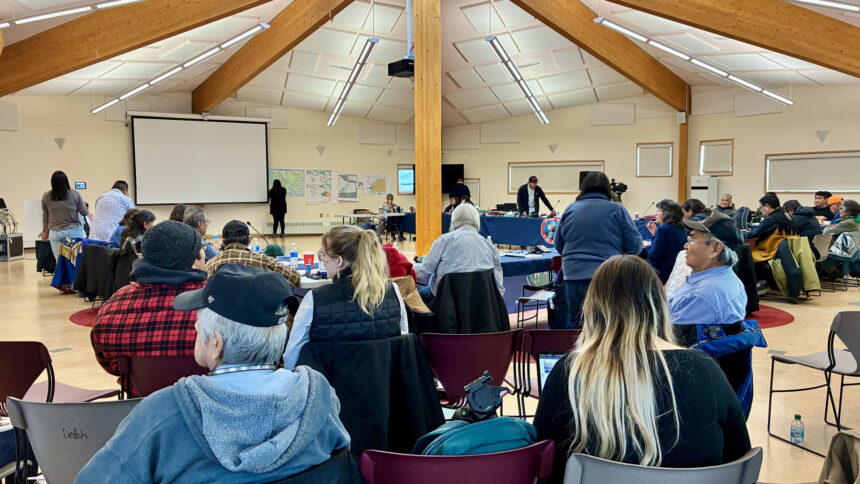
Northwest Territories Premier R.J. Simpson says the territorial government will begin discussions with Yellowknives Dene First Nations on formalizing their authority over child and family services, following concerns raised at the Annual Akaitcho Assembly about Indigenous children in care. Speaking to delegates at the Chief Drygeese Centre on Oct. 28, Simpson said that while Indigenous governments already have the authority to care for their own children, the next step is to begin working toward a coordination agreement between governments under federal legislation. “In terms of the child welfare piece, we will begin those conversations,” Simpson said. “It’s federal legislation, and it requires an implementation,” said Simpson. The discussions come as delegates described children being separated from their siblings and communities, families struggling to access services and concerns about whether the child welfare system adequately reflects Indigenous cultures and ways of life. According to a 2026 federal audit, 98 per cent of children who receive prevention and protection services in the N.W.T. are Indigenous, despite making up only about 58 per cent of the territory’s total child population. Around the table, delegates said the issue is not only where children are placed, but whether the system supports families, keeps siblings together and allows children to maintain meaningful connections to their language, culture and communities. Foster care needs more support, delegates say Jeffery Rosnawski, a delegate, called for stronger oversight of foster homes and more support for Indigenous people who want to become foster caregivers. “It seems that it’s more like a business. You have a lot of people coming to the north and they’re opening their doors, but they’re getting compensated really well,” Rosnawski said. He called for ongoing audits to ensure foster homes are meeting children’s needs and not taking advantage of the system for financial gain. Rosnawski said the issue extends beyond foster homes to the child protection workforce itself. He argued that social workers need a better understanding of the families they serve and that Indigenous representation in the system should reflect the population. “A lot of our members whose kids are in foster homes they’re going to some of these homes and and you know they’re not even talking English in the homes and they’re not eating the same food that they would if they were in the community,” he said. He also raised concerns about how families are treated when they are already struggling. “Sometimes you have to be empathetic and it should be taught,” Rosnawski said, calling for improvements to staff orientation and cultural understanding. Rosnawski said the territory also needs a family-treatment program so parents working toward reunification can receive support closer to home rather than travelling south and being separated from their communities. Leaders discuss the child welfare at the annual Akaitcho Assembly. Photo: Charlotte Morritt-Jacobs/APTN. ‘If we need housing, help us’ Charlie Catholique, a foster parent from Deninu Kųę́First Nation, said he and his wife have cared for more than 30 children since 1999. He told delegates that communities need more resources, including larger homes, to make it possible for local caregivers to take in children who might otherwise be sent away. He described caring for a young child who had been moved through five homes before reaching his first birthday. Catholique said children who have experienced trauma need stable homes and caregivers who can offer the support they require. He said his own household has only been able to care for a limited number of children at a time. “If we need housing, help us. That way more kids will stay home,” he said. Catholique said children are sometimes sent outside their communities and separated from their siblings because local caregivers cannot accommodate them all. “They leave the community, go to Edmonton sometimes, right here. And they’re separated. They’re not together. We should be, we should always keep them together,” he said. He also pushed back against the idea that foster care should be treated as a source of profit. Catholique said caregivers need enough financial and practical support to meet children’s needs, but that caring for children should be rooted in a commitment to them. His comments point to a practical barrier for communities hoping to keep children close to family: Indigenous caregivers may be willing to help, but need housing and resources to do so. Families need help, not separation Vanessa Sangris said she has advocated for families who struggled to get support for a child with mental-health needs. In one case she described, a child had to be sent south because services were unavailable in the territory. “One child had to be sent south. Because there’s no services for that child here,” Sangris said. She said the family was approved to attend treatment in the South, but encountered difficulties with child services while trying to get help for the child. “And they didn’t help the parent; they didn’t explain the symptoms, the conditions, anything. They didn’t help them with anything,” Sangris said. Sangris said the family complied with the requirements set by child services but still faced the possibility of losing their other children. She said the experience raised questions about whether the system was supporting families through difficult circumstances or making separation more likely. Sangris called for child and family services to return to Indigenous communities, arguing that communities need the authority and resources to support their own families. “Because the whole residential school issue, it has to be us that takes care of them. They’re gonna heal from us,” she said. She said Indigenous families are still relearning aspects of parenting and cultural life after generations of children being separated from their communities. Chief shares family’s experience Yellowknives Dene First Nation Chief Fred Sangris drew on his own family’s experience to explain why he believes Indigenous communities should direct child welfare services. “I met them for the first time when they were 11 years old,” Sangris said. “They don’t speak our language. None. They have no culture. They have no relationship to our family, Indigenous people, or community. None.” Sangris also described intervening on behalf of extended family when a mother passed away. He said he believed the family was being judged unfairly and that he challenged child services officials alongside his relatives. “I said we are prepared to challenge this and go to court if we have to,” he said. Sangris said the children were returned to the family after the meeting. His account was part of a broader argument that Indigenous families should be trusted and supported to care for their own children, rather than having decisions made without adequate understanding of their circumstances or culture. He compared the child welfare system to earlier policies of assimilation, saying the removal of children can sever their ties to language and community. “When Jean Chrétien came to become Prime Minister of Canada, he produced a white paper called the Assimilation Policy. That is the same thing happening with child welfare,” Sangris said. He called on the territorial government to allow Indigenous communities to make decisions about their own children. “Child welfare, the government of the North Territory needs to let go and let the Indigenous people decide for themselves what’s best for them,” he said. RJ Simpson, seen here after the 2023 territorial election, says the territory ‘inherited a system that is a Western-style system, colonial style system, and it’s difficult to just overlay culture on it.’ Photo: Charlotte Morritt-Jacobs/APTN. NWT outlines next steps Simpson acknowledged the cracks in the system. “We inherited a system that is a Western-style system, colonial style system, and it’s difficult to just overlay culture on it, paint some culture onto the system and have it work effectively for people,” Simpson said. He said the government is working to change the system from the inside out and develop a formal process for concerns about child and family services to be heard and investigated independently of the department. Deputy minister of Health and Social Services Alan Doody told delegates the territory is working with Indigenous governments to develop foster-care training specific to the N.W.T. Training developed in Ontario was considered unsuitable after Indigenous government staff reviewed it. Doody also pointed to the reintroduction of a social work program at Aurora College in Fort Smith, N.W.T., which could help build a local workforce. The program was paused in 2018. The assembly discussion turned to legal pathways for Indigenous governments to have responsibility for CFS. The federal Act respecting First Nations, Inuit and Métis children, youth and families, passed in 2019, recognizes Indigenous peoples’ inherent right to govern child and family services. The law provides a process for Indigenous governing bodies to seek coordination agreements with Canada and the relevant provincial or territorial government. First Nations in the N.W.T. are not involved in the child welfare complaint process taking place at the Canadian Human Rights Tribunal because the program is paid for under a different agreement. After a direct call from Chief Sangris to hand over child welfare authority to Yellowknives Dene First Nation, Simpson said the territory would begin those conversations, with staff expected to reach out to start the process. “I don’t even like saying the transfer of authority. You have the authority to do it already,” Simpson said. “It’s inherent that you have that right to take care of your children.” In November 2021, the Inuvialuit Regional Corporation secured jurisdiction over child and family services through a landmark coordination agreement with the federal government and the Government of the Northwest Territories. The agreement included $533.5 million in federal funding over 10 years to support the transition to Inuit-led services under the Inuvialuit Qitunrariit Inuuniarnikkun Maligaksat. After the discussions surrounding child welfare, delegates voted to move into an in-camera session for land claim negotiation updates, closed to the media, before the day’s proceedings concluded. Charlotte Morritt-JacobsVideo Journalist | YellowknifeCharlotte joined APTN in January 2017 as a video journalist in Yellowknife, N.W.T.. Before coming to APTN she interned at CTV Lethbridge, earned her BA in feminist research from Western University and obtained her post-graduate in journalism at Humber College. Continue Reading
N.W.T. premier commits to advancing Dene control of child welfare



Leave a Comment