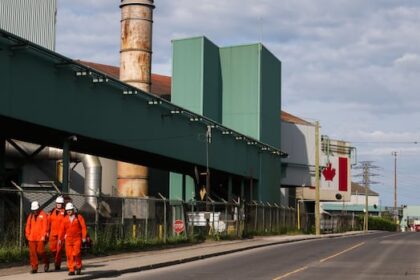
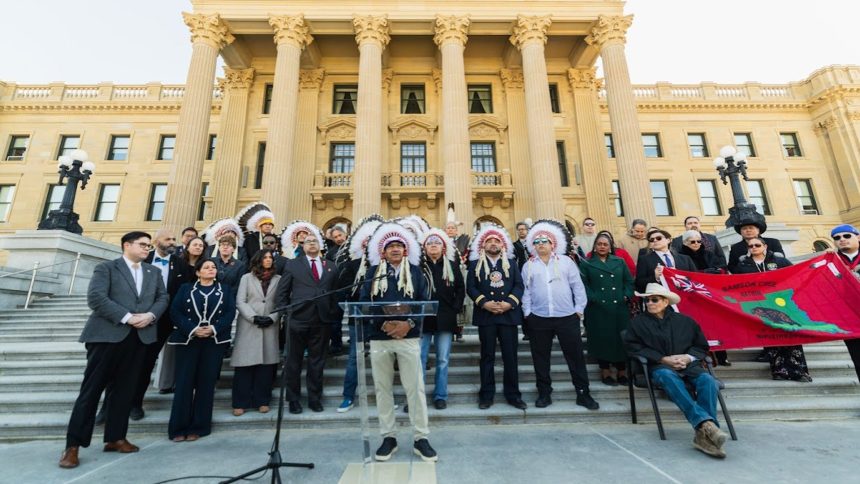
Sturgeon Lake Cree Nation (SLCN) says it has won its first legal skirmish in its battle against a proposed AI data centre on its territory. In April 2025, it asked the Federal Court to examine the government’s decision to approve the project in what is called a judicial review. The data centre is being proposed by celebrity Kevin O’Leary through his company O’Leary Digital Limited, or ODL. The Former Dragon’s Den investor was trying to have SLCN’s application for a judicial review of the granting of a water license quashed. However, Court of King’s Bench Justice P.K. Johal dismissed ODL’s application. “ODL’s connection to the Water Licence is both contingent and speculative, which cannot support a finding that they are directly affected by SLCN’s judicial review application,” Johal wrote in his ruling filed Aug. 13. “ODL’s alternative applications for intervenor status or to be added as a respondent are also dismissed.” SLCN requested a judicial review of Alberta’s approval of a water licence to the municipal district of Greenview because they hadn’t been consulted. Chief Sheldon Sunshine said in a statement that this is the first legal victory. “This means that SLCN’s judicial review of the Water Act Licence, including a challenge to Alberta’s failure to consult at all, will go ahead in December,” said Sunshine. “Sturgeon Lake Cree Nation is happy to have the opportunity to vindicate our Treaty rights and hold the Crown accountable on consultation. “O’Leary’s data centre here in Alberta is a mind-boggling, massive project, which the province has been shepherding through their regulatory system using the municipality to evade their duties to us. There is no environmental assessment and next to no consultation with our nations.” SLCN launched its application for a judicial review in 2025. Over several months, SLCN tried to find out more about the project, whose ownership was then identified only as a numbered company. Once the nation filed for a judicial review, ODL made itself known, according to court documents. ODL lawyers argued the review should be denied. The water license permits the municipality to divert six million cubic meters of water from the Smoky River along which SLCN has Treaty 8 reserve lands and where they “exercise their traditional Treaty and Aboriginal rights.” SLCN served notice of its judicial review application on the municipality of Greenview, as the water licence holder, and on Alberta for granting the water licence. ODL responded to the decision in a statement provided to APTN News on Friday. “While we respect the Court’s process, OD is disappointed with the decision and strongly disagrees with the continuation of this proceeding. We are currently reviewing the decision in detail and will reserve further comment until that review is complete,” the statement by CEO Paul Palandjian said. “From the outset of the Wonder Valley Project, ODL has worked in good faith to engage and consult with SLCN and other Indigenous and local communities,” he added. “We believe Wonder Valley represents a significant opportunity for Alberta, the region and the surrounding communities, and we remain focused on advancing the project in a responsible manner under appropriate regulatory oversight.” According to court documents, ODL has plans to build a $70 billion artificial intelligence data centre industrial park in the Greenview Industrial Gateway or GIG. The application heard Aug. 8 to strike SLCN’s judicial review application was on the basis that ODL, as a “directly affected party,” was not served within the timeframe prescribed under the Alberta Rules of Court. Failing that, the company requested intervenor status or to be added as a respondent to the judicial review. Sturgeon Lake Cree Nation “is presumptively entitled to costs. If the parties cannot agree on costs, they may provide written submissions of no more than five pages, not counting attachments, within 30 days” of the decision,” Johal ruled. According to facts presented to the court, “the GIG is comprised of 7,000 acres of provincial land in northwest Alberta. SLCN’s Treaty lands are located within the GIG. In 2024, land within the GIG was transferred from Alberta to Greenview.” Information on the province of Alberta’s website regarding its AI Strategy says “a data centre is a warehouse full of computers. Rows of powerful servers, stacked in racks, connected to the internet, running around the clock. You have been using them for 20 years. Every email you send lives in a data centre. Every photo you back up, every show you stream, every e-transfer you send, every medical record your doctor pulls up.” It goes on to say that “when people say ‘the cloud,’ they mean a data centre. There is no cloud. There is just somebody else’s computer, in a big building, doing work on your behalf.” While data centre projects can create around 3,000 jobs while under construction, only about 300 permanent jobs will remain once operating, according to Alberta. According to O’Leary Digital’s website, it considered four locations in Alberta including “Greater Calgary, Medicine Hat, the Industrial Heartland and the Municipal District of Greenview near Grand Prairie.” The Grand Prairie site is where ODL found what it calls “a total unicorn.” “You need an acre per megawatt. We needed thousands of acres. We have that in the Greenview Industrial Gateway, or GIG, said Palandjian. “They had assembled the land. They had established permitted use of the land. They had spent a tremendous amount of time and resources in upgrading the land by improving Highway 40 and adding fiber backbone.” The clincher, he said, was the power. “Producing power from natural gas is much cheaper than buying nuclear energy…and whether you use nuclear or natural gas, they require a tremendous amount of water. Very few communities have this kind of water. The GIG does. The GIG has everything we need within close proximity.” Environmental groups and individual residents are growing increasingly vocal in their criticism of AI data centre projects, demanding stricter environmental scrutiny, transparency, and mandatory impact assessments due to concerns over the strain on water supplies and the potential to hike up utility costs and heighten the demand for fossil-fuel generated power. Sunshine said Albertans are now seeing what Sturgeon Lake Cree Nation has been living through for 20 months. “The province will push these hyperscale massive data centres in our backyards despite serious concerns,” Sunshine said. “The province’s answer is ‘just trust us…,’ if these massive data centres cause no harm, we ask that the province and O’Leary show us all the designs, the technical reports and let us assess these too, like every other project of this scale.” Continue Reading
Sturgeon Lake Cree Nation in Alberta claims victory in first battle against mind-boggling, massive AI data centre



Leave a Comment