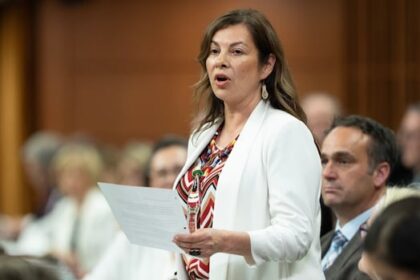
The 2026 U.S. midterms resulted in several firsts, including the victories of Peggy Flanagan and Deb Haaland, the first Indigenous women to serve as state senator and governor, respectively, in the country’s history. “My ancestors came to the Rio Grande Valley in the late 1200s, and this beautiful land has sustained all of us for generations,” Haaland said in her victory speech Tuesday night. “Just off this road, my grandmother was taken to boarding school, and along with my grandfather, survived through a time when the federal government attempted to strip them of their languages, traditions and identities. Yet, we are still here.” Although the results have not been finalized, the Democrats have been favoured to win the U.S. House of Representatives (236 seats to 129) and Senate (54 to 44), a sweeping result which flipped 29 seats from red to blue, as of Wednesday afternoon. Midterm elections are held two years after a presidential election. All members of Congress, also called the House of Representatives, are up for election, and 33 of the Senate’s 100 seats were up for grabs. Alongside Flanagan (Minnesota) and Haaland (New Mexico), the midterms also brought in Abdul El-Sayed, the first Muslim senator in Michigan; Chris Pappas, the first openly gay senator in New Hampshire; and Keisha Lance Bottoms, the first Black female governor in Georgia. The Associated Press (AP) reported that the win for blue was the result of “a revolt against President Donald Trump’s policies,” including the tariff war with Canada and the ongoing war with Iran. Twice as many voters wanted to “express opposition” to Trump, compared to those who wanted to support him, according to results from an AP national poll, which resulted in Democrats gaining control of historically red states such as Texas and South Carolina. Democrats are “ready to launch a 100-day agenda to lower the costs of gas, groceries and healthcare and conduct vast oversight and investigations into Trump and his administration, with impeachment an option,” the AP continued. In a 25-minute victory speech, Flanagan said, “no more ballrooms, no more bombs and tax breaks for billionaires … The grift stops now.” Flanagan was one of several populist candidates in the 2026 midterms, with a campaign that “did not represent billionaires,” she said, and supported Treaty rights. Flanagan, who is Ojibwe, won with a 10 per cent lead. Although she is the first Indigenous woman in the Senate, she isn’t new to politics — she was elected as the state’s lieutenant governor in 2018 and served in the Minnesota House of Representatives from 2015 to 2019. She was also the first woman of colour to be elected to statewide office in Minnesota, according to the Center for American Women and Politics, and was the highest-ranked Indigenous official in the country at the time of her 2018 win. “The name you voted on the ballot says Peggy Flanagan, but my Ojibwe name speaks in a loud and clear voice,” she said. “You helped a small and scrappy, often underestimated enrolled member of the White Earth Nation become the first Native American woman in history to be elected to the U.S. Senate.” Flanagan is credited as the driving force behind Minnesota’s Missing and Murdered Indigenous Relatives office, the first state-wide office of its kind in the country. She was also a vocal advocate when it came to passing the Minnesota Indian Family Preservation Act, a law which notifies Indigenous American governments when a child enters the welfare system, as well as strengthens family protection for Indigenous Peoples, in 2023. It’s Indigenous Peoples Day in Minnesota – an opportunity to embrace the power, beauty, and richness of our community. We are resilient, we are still here, and we will always be here in Mni Sota Makoce. pic.twitter.com/uMZCdGb3Te — Lt. Governor Peggy Flanagan (@LtGovFlanagan) October 12, 2026 According to the AP, she had been the favoured successor for former Minnesota governor Tim Walz in 2024, when he had run for vice president to Kamala Harris in that year’s presidential election. In her speech, she thanked Walz for his “historic work to strengthen tribal-state relations.” “To all the young people out there who look like me, to the daughters and to the sons who too often are forgotten or erased, I see you,” she said. “Do not be disheartened that it took 250 years for one of us to get here, be inspired by the fact that with grit and determination, and the resilience of our people, whichever one of you is next, you’re going to get here a lot faster.” Affordability biggest issue to U.S. voters: poll On social media, Manitoba Premier Wab Kinew stated that he was looking forward to working with Flanagan, “to lower costs on both sides of the border by ending the war in Iran (gas and diesel prices) and the Trump tariffs (the price of everything else). “The American people have delivered a resounding rejection of the President’s actions over the past two years,” he continued. “Canadians are ready to rebuild the relationship and strengthen our economies.” Ontario Premier Doug Ford was also happy with the results. Wednesday morning, he told reporters the democratic sweep was “a victory across the world.” “I was doing cartwheels down the street,” he said. “The American people spoke on a couple of issues. Cost of living, the cost of gas, the war in Iran, but most important: tariffs.” Ford’s claim has backing. According to a national poll organized by the AP, 39 per cent of participants said the economy was the biggest issue on their mind as they went to the polls, followed closely by “the state of democracy,” at 33 per cent. However, policy analysts aren’t sure if the midterms will bring any immediate relief from tariffs in particular. Speaking to AP, University of New Brunswick political science professor Donald Wright said Trump still has the executive powers he used to enact the tariffs, and isn’t likely to back off because of election results. “A vindictive president might want to hurt Maine [which flipped to blue as a result of tariff costs, according to poll results] … he could re-implement some of the tariffs that he lifted,” Wright said in an interview. Democratic gubernatorial candidate Deb Haaland campaigns along a roadside in San Felipe Pueblo, N.M., on Tuesday, June 2, 2026. Photo: Susan Montoya Bryan/AP Photo. Haaland ‘breaking barriers’ says Manitoba Minister Nahanni Fontaine Asking to put tariffs aside, Manitoba Minister of Families Nahanni Fontaine added that she hopes the result reminds the Canadian public of the power of civic engagement. “Indigenous women, girls and Two Spirit, as folks know, face horrific levels of violence across Turtle Island,” she said, in a video posted to social media. “The Trump regime just took down all of the MMIWG2S information from its government websites, because it doesn’t care, and so Deb Haaland becoming the first Indigenous woman ever elected governor is a huge deal. “She’s breaking barriers that have stood for generations on our own lands.” Haaland, a member of the Pueblo of Laguna, is also experienced in politics, having served as the U.S. secretary of the interior from 2021 to 2025 under former president Joe Biden. Prior to this, she was elected to the U.S. House of Representatives in 2018, becoming one of the first two Indigenous women to do so, alongside Sharice Davids. There, she was a member of the House Committee on Natural Resources and advocated for abortion rights, especially in the case of Indigenous American women. According to the National Library of Medicine (NLM), Indigenous women in the U.S. are far more likely to experience sexual assault resulting in pregnancy, and have had restricted access to reproductive health due to the Hyde Amendment, a federal law passed in 1976 that prohibits federal funds for abortion. Because Indigenous Peoples in the U.S. receive the majority of healthcare services through federally-funded Indian Health Service facilities, this has “effectively denied Native American women access to full-scope women’s health care, that includes access to abortion,” according to NLM. Haaland was very vocal about closing this gap through “using state funds to backfill lost federal support,” according to her campaign. Also a populist candidate, she said she’d hold the president to account: “I’ve stood up to Donald Trump before, and I’ll do it again.” Haaland also hopes to reform New Mexico’s Children, Youth and Families Department (CYFD), as well as pass bills which would increase funding for public school curriculum on reserve land. A third Indigenous win predicted for Alaska In the north, results from Alaska are coming in at a far slower pace, but democratic candidate Mary Peltola is currently leading by only one per cent, as of Wednesday. Peltola was the first Alaska Native member of Congress, elected in 2022, and a former tribal judge. Joshua Brass Fraser, an Alberta-based political scientist who has run the Indigipoli X (formerly Twitter) account since 2015, said he was the first to predict Flanagan and Haaland early Tuesday evening, and suspects Peltola will follow suit. “It’s an exciting time, and we’re just hoping for Peltola, but I think in the end, I think she’ll pull through,” he said. He said most of the votes that have yet to come in are from an urban voter base, which was the same demographic responsible for the final push to elect Flanagan in Minnesota. Thank you, Alaska! pic.twitter.com/qLiPtPFI0w — Mary Peltola (@MaryPeltola) November 4, 2026 He said having two Indigenous women in the Senate will see “strong change, very much like so in Canada, with Minister of Indigenous Services Mandy Gull-Masty and Minister of Northern Affairs Rebecca Chartrand. “It’s always good to have a partner in the Senate you can work with, if anything in the past, the past has shown that Native American women elected in the United States, they’ll often work together.” Brass Frasier added that, while Haaland’s win in New Mexico was “huge,” U.S. Senators have the power to hold Trump’s administration to account, and he’s “excited” to see what they can do. “Senators are much more powerful, and that’s why having two Indigenous senators is so huge, and both senators come from states that have large Indigenous populations,” he said, adding that the electoral body doesn’t acknowledge rural Indigenous communities in the U.S. “as much as they should.” He said ultimately, “I’m sticking with my projection that Peltola will finish this off.” ‘Record-breaking year’ for Indigenous civic engagement, data shows Across the entire scope of the 2026 U.S. election season, there were more than 360 Indigenous candidates running for not only for Senate and governor positions, but for the U.S. House of Representatives and municipal office. Only two Indigenous candidates were elected to the House — Claire Valdez in New York and incumbent Sharice Davis in Kansas. Advance Native Political Leadership (ANPL), a non-partisan political advocacy organization that collected the data, stated that this was a “record-breaking year.” Results also indicated a 37 per cent jump in Indigenous candidates since the 2024 presidential election. Brett Chapman, an Oklahoma-based defense attorney and member of the Pawnee Nation, said “Native American representation in government was all but nonexistent” 30 years ago, when he was growing up, but he agrees that there has been “a record number of Native candidates vying for public office all across the country. “More and more each time,” he said. “I think this is really great to see, and it matters greatly to tribal sovereignty because it’s a government-to-government relationship, and when you have people on both sides that understand the importance of the issues, you get better results for Indian country.” Chapman said he wasn’t surprised it took this long to see Indigenous Peoples in governor or Senate roles. “For most of American history, federal and state policy worked to keep Native people out. Out of our own lands through removal, out of the larger community by confining us to reservations, and out of citizenship and the voting booth until the last hundred years,” he said. “Policies like that are intended to carry consequences forward for generations, and yesterday’s results show both how long those consequences last and also that they aren’t permanent. “So I was really satisfied to see so many Indigenous women accomplish something great.” With files from the Associated and the Canadian Press Emma HoneybunOnline Journalist | WinnipegEmma is a Red River Métis with family roots in St. Malo, Manitoba. She graduated from RRC Polytech’s Creative Communications program in 2023 and went on to serve as a community journalist and photographer for the Free Press Community Review until she joined APTN in 2026. Equipped with a strong sense of justice, she enjoys covering stories in the central prairies for a larger audience. Her work has also appeared in Manitoba Inc. Magazine, the Free Press, and RRC Polytech’s student paper, The Projector. Continue Reading
The grift stops now: Democratic midterm elections sweep brings in first Indigenous governor and senator in U.S. history

Leave a Comment