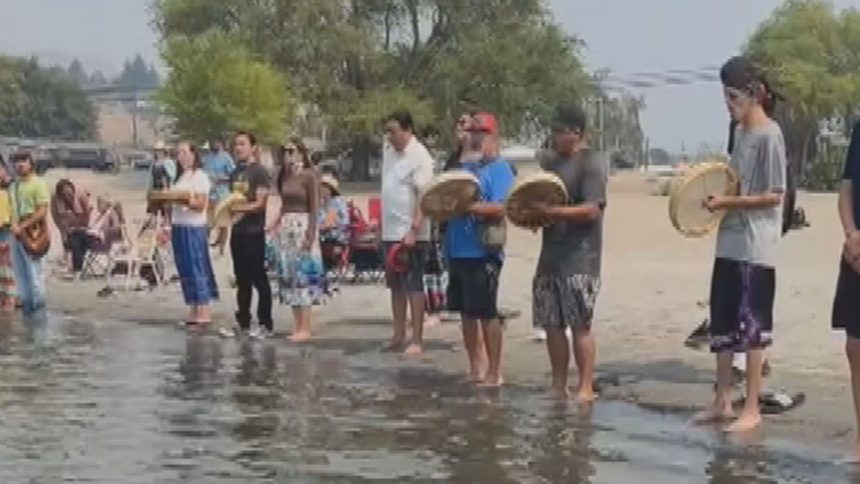
As wildfires continue to burn across British Columbia’s Okanagan region, waterways across the Syilx territory are filled with prayer and ceremony, The Okanagan Nation Alliance called people together on Wednesday under the nən̓syilxcən phrase: x̌əli kʷu sqilxʷ | x̌əli kʷu tmixʷ | x̌əli kʷu siwłkʷ It’s a call for people to unite their prayers during the wildfire crisis. The expression centres the people, all living things and the waters as part of that collective responsibility. Prayer gatherings were held at waterways throughout Syilx territory, including Kin Beach in Vernon, Okanagan Beach in Penticton, Westbank, Nehumpchin Creek, Upper Nicola, nk’mip Creek in Oliver and Omak, Washington. For Jennifer Lewis, wellness manager with the Okanagan Nation Alliance and a member of the Penticton Indian Band, bringing people together was about creating space to pause during an overwhelming crisis. “I think it’s always really grounding and connecting,” Lewis said. “We remember that we care for each other.” She said the gatherings allowed people to reconnect with the land and each other. “Bringing us together and finding some of that grounding and healing with the land, with the relationships we have with one another,” she said. “I think for a lot of people, to pause for a moment, it brought up a lot of emotions from a lot of people as well.” No timeline for residents to return The prayer gatherings came as uncertainty continues for thousands of families displaced by the wildfires. In its latest update Wednesday morning, the Regional District of Okanagan-Similkameen said there were no overnight changes to evacuation orders or alerts. Rapid damage assessments have started in Trout Creek and North Beach, but the area remains unsafe because of active fire. Officials said there is currently no timeline for re-entry, noting that essential services such as power, utilities, waste disposal, roads and other safety measures would need to be in place before residents can return. The entire District of Summerland remains under an evacuation order, covering more than 5,600 properties. In the Penticton Indian Band, 38 properties are under an evacuation order and another 1,082 are under an evacuation alert. For Jennifer Lewis, the impact of wildfire is personal. She remains on evacuation alert, while her sister and her family are under an evacuation order. Lewis also has family members in the Okanagan Indian Band who have lost their homes. “It’s devastating. It is absolutely devastating to have this fire come through, you know, not five years from the last one, almost to the day,” Lewis said. In the 2021 wildfire, Lewis said her mother lost her childhood home by the Okanagan Indian Band, where Lewis was raised. Her sister also lost her family home. “Many of our families lost their homes in the 2021 fire,” she said. That history is part of why Lewis said the prayer gathering was about more than simply responding to the immediate emergency. It was about remembering the relationships between people, the land and water, and creating a space for people to release some of the fear and uncertainty they are carrying. “We wanted to provide space across the nation that we could pray at the same time and bring people to the water,” Lewis said. “Water’s medicine. Water’s healing.” ‘Water’s medicine. Water’s healing.’ Wildfires continue to rage in parts of British Columbia. The decision to gather beside the water was intentional to incorporate traditional and cultural practices into responses to crisis. They initially gathered people for prayer. Then they decided to expand the idea across the nation. “There’s so many of our people that are impacted by the wildfires in so many different ways,” Lewis said. “Whether it’s evacuation orders, whether they lost their homes, whether they’re on alert. All of our families are out there fighting the fires in many different places across the territory.” The Penticton gathering was also opened to members of the public, including evacuees staying in the area. Lewis said some people who attended told her they were looking to First Nations for leadership during the crisis, not only around land management and wildfire response, but also for spiritual and cultural guidance. “I felt like that’s a lot of reminders that we hold a lot of tension in our bodies and in our spirits,” Lewis said. “When we sing and we saw this prayer, or drum songs and prayer, that allows that to go through us and we don’t have to hold on to it.” Reframing the relationship with fire The ceremony was also an opportunity for Lewis to reflect on the relationship between the Syilx people and fire. “I wanted to really remember for myself that fire is an element that is here,” she said. “It’s a really important and really strong medicine, actually.” Lewis said colonial policies have disrupted Indigenous peoples’ ability to maintain their traditional relationships with fire. “In this society we learn to fear it because we’ve been so removed because the government has impacted our ability to do that relationship in many ways,” she said. She said fire also has a role in cleansing and rejuvenating the land. That relationship, she said, is connected to the water, wind, land and all living things. She said modern society has also created a different relationship with fire because people live in permanent homes filled with belongings. “We have this fear because we now live in homes that can’t be moved and it has all of our belongings,” she said. “We were never intended to live this way.” ‘We really come together in times of need’ A helicopter conducting night operations prepares to drop water on the Quilpituk Creek wildfire burning on the west side of Okanagan Lake near Fintry, B.C., late Monday. Photo: Darryl Dyck/The Canadian Press. While the fires have brought devastation, Lewis said they have also demonstrated the strength of the Syilx Nation’s collective response. The Okanagan Nation Alliance has been supporting Okanagan Indian Band leadership, offering staff and services while also monitoring threats to other Syilx communities. “We’ve been offering every service that we can,” Lewis said. “We’ve been helping problem solve and troubleshoot things, offering staff because their staff is running nonstop.” She said support has also flowed between communities. “When Okanagan Indian Band was one of the only fires in the territory, all of the communities reached out to support them to say, ‘What can we do?’” Read More: ‘We measure it in memories lost’: Bradley Creek wildfire leaves Okanagan Indian Band community facing long road to recovery That same response is happening now as other communities face threats. “We really come together in times of need,” Lewis said. “We really come together for that community care and that nation care.” For Lewis, that collective response is one of the most important lessons coming from the crisis. “I think that while it’s devastating, it’s also a gift to remember that we belong to each other and that when we care for each other, we can get through anything,” she said. The fires have brought grief, uncertainty and loss, but Lewis said the prayer gatherings have reinforced a message of connection. Continue Reading
We belong to each other: Syilx prayer gatherings offer grounding as wildfires devastate Okanagan



Leave a Comment