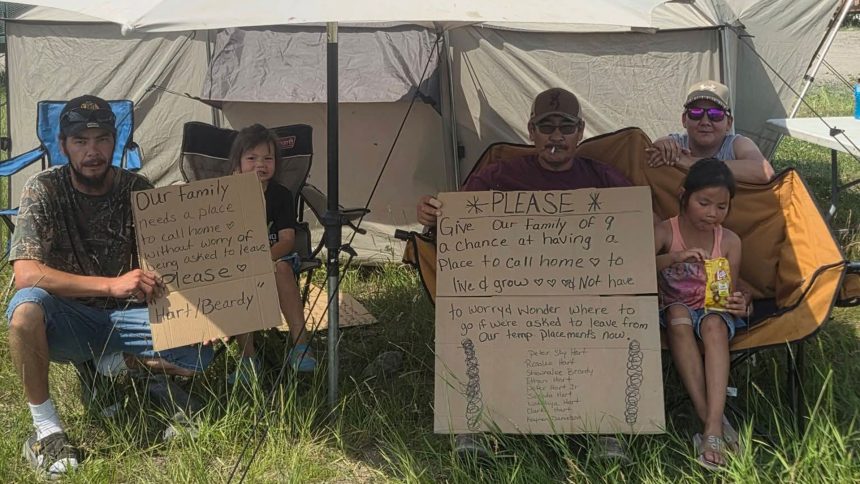
Members of Pukatawagan say they’ll camp outside the community’s band office until chief and council do something about the housing crisis. People have been living in a protest camp outside the band office since July 15. They say the crisis has led to families either living in small rooms or relocating in order to find housing. According to resident Rosalee Hart, those protesting intend to stay there until there is an outlined plan for change. “I know nothing’s going to happen overnight,” she said. “It may be in time as our kids get older, things will start processing and moving along, and maybe we’ll get more houses up, I don’t know. “For now, we really just want to be heard and seen, we’re still waiting, just wanting to see when or if we’re going to get a place to call home.” Pukatawagan is a Cree community located about 700 kilometres northwest of Winnipeg. Hart said members of the camp were scheduled to meet with Chief Gordie Bear and council on Monday, but the meeting was postponed. So for now, she said, they’re waiting. The community, which is also known as Mathias Colomb Cree Nation or the nickname “Puk,” is home to approximately 3,500 people, but only has 435 houses, according to Indigenous Services Canada (ISC). Because of this, families with up to seven children are living in single rooms, Hart said, and many members are homeless or sleeping on other people’s couches. “There’s many families and other people that don’t have places to actually stay, that go wherever they’re allowed to,” she said, calling from the camp, where she has been staying with her six children (aged four to 17) and five-month-old grandson. Hart and her family do currently live in a two-bedroom trailer, and it’s crowded with little room for furniture, but it’s a roof over their heads. However, it’s temporary. “It’s still under education (at the band office), because I was working at the education department at that time [six years ago],” she said. “And they told us it would be temporary until we can get our home. So with nine of us now, and we’re still in that temporary home, it’s really frustrating. Because my kids are only getting bigger.” However, there’s no housing available to them because everything is full. “We need a place to call home and not worry about somebody coming to ask us to leave our temporary home because they need it for something else,” Hart said. “And then the other families that are here, they live with a family member or a friend, but they only have one room … Even single people deserve a place to just live comfortably without having to go sleep here, go sleep there, wherever they’re allowed to lay their head for the night.” APTN reached out to the community’s band office but did not hear back. This story will be updated if a response is received. Residents say that the camp outside of Pukatawagan’s band office is to raise awareness against a long-standing housing crisis. Photo: Nekapewanew Iskew/Facebook. Housing backlogs in Pukatawagan date as far back as early 2000s For decades, overcrowding in Pukatawagan has been in the news. In 2006, CBC reported that the community was facing a severe housing crisis, “with a backlog of more than 300 homes.” The article noted that an average of nine people lived in each house. At the time, the community had a population of about 1,400 people, according to the article — almost 2,000 fewer than today. In 2019, 25 houses were built by Missinipi Construction, an independent company established to keep funding related to infrastructure in the community. In 2021, APTN News reported that, in order to meet the needs of the growing community at that time, Missinipi would have had to continue building 33 houses a year until 2030. The same article reported that many of the developments along Roos Road were infested with mould because of seasonal flooding. Although leadership reported that they had “obtained a ministerial loan guarantee” to pay for housing developments in an effort to meet the 2030 goal, the issue remains. Hart said there are currently four brand-new developments in the community, but the families who moved in were evicted after only a few weeks due to safety concerns related to the state of the buildings. Resident Gladys Sinclair told APTN that the new developments do not have running water, and confirmed that older properties are still dealing with mould and lack of repair. She said her brother, Hycinthe Colomb, is in the process of being evicted from one of the new homes, along with his seven children. He had been forced to leave his previous home because it had “moulded hard-core,” she said. “Rotten, smelt bad, and the walls were falling apart,” Sinclair said. “They’re trying to kick them out of that house, so sad. “No home to go to. What, they expect them to live outside … they should just give them that house.” Sinclair said that she and a friend do have two-bedroom trailers promised to them, but they’re located 10 kilometres away at a nearby train station. “Puk is isolated, only can go by train or plane or winter road,” she said. “I don’t know when they’ll be able to haul them [here], hopefully soon. I’ve been moving house-to-house all these years, couch surfing too, and finally I’m getting my own home. I’m relieved.” 108,803 housing units needed across Canada: ISC APTN reached out to Indigenous Services Canada (ISC) and the Canada Mortgage and Housing Corporation (CMHC) to ask for updated data in relation to how many houses are still needed on First Nations to combat the overcrowding crisis, with an emphasis on Pukatawagan. We also asked how many have been built since 2021. In response, the two federal sectors collaborated with Housing Infrastructure and Communities Canada (HIC) to form a joint statement, which was sent by email. In the statement, the federal government wrote that ISC and CMHC are working in collaboration with Crown-Indigenous Relations and Northern Affairs Canada to deliver the Indigenous Housing Strategy, which was previously announced in the 2025 federal budget. “Supporting the transfer of housing services to First Nations is part of [ISC]’s mandate,” a CMHC spokesperson wrote, on behalf of the three sectors. “The department is working with First Nations on a community-by-community basis to develop and implement programs and initiatives that build capacity and support the transfer of service through holistic, community-based approaches.” According to a 2023 report from ISC and the Assembly of First Nations, which outlines possible solutions to “close the infrastructure gap,” of an estimated 85,700 existing housing units, 34 per cent required minor repairs and 31 per cent required major repairs. It states that an additional 108,803 housing units would be needed to address overcrowding, replacement, and population growth. For Pukatawagan in particular, ISC said it has provided almost $25 million split between housing construction, renovations, and additional funding to be spent based on priorities determined by the First Nation since 2017. Pukatawagen has also received six secured loans of more than $12 million from ISC to construct 51 housing units in partnership with the CMHC However, there is no confirmed timeline on when new houses and repairs will be completed, according to Hart, which was a motivation for the protest. The federal government added that since 2016, more than $6.4 billion from ISC has supported over 32,000 homes and serviced lots in First Nations across Canada. As well, since 2020, CMHC has allocated $740 million to support 3,564 housing units in First Nations in Manitoba, specifically, using programs such as the Affordable Housing Fund, Rapid Housing Initiative, and more. However, there is an undetermined number of houses that have been impacted by damage such as flooding and mould. Rebecca Chartrand, member of Parliament for Churchill-Keewatinook Aski, and the federal minister for Northern Affairs, said she was aware of the protests in Pukatawagen. “I empathise with the frustrations of community members who are facing serious housing challenges,” she wrote to APTN. “Every person in Canada deserves access to safe, adequate housing and a healthy living environment.” Chartrand said that she understands that housing shortages, overcrowding, and a “need for safe housing” are issues shared by several communities in her riding. “These challenges have a profound impact on the health, well-being and future opportunities of families across Northern Manitoba,” she said. Chartrand added that she is currently in talks with Gregor Robertson, federal minister of housing and infrastructure, regarding housing needs in northern and remote communities such as Pukatawagen. “I am committed to working with the leadership and staff of Mathias Colomb Cree Nation, as well as federal partners, to better understand the immediate needs of the community and support long-term solutions. Community voices, local knowledge, and leadership must be at the centre of any efforts to address these challenges,” she said. Hart said that the camp is not necessarily a protest, ultimately, but a way to spread awareness and advocate for change. She said she was initially scared to speak up about the continued plight in the community, but wanted better for her kids. “I just thought, okay, like it’s time to bring this to the light and see if anything can be done, or in the future, just to get things going and just to know like… we’re still here, and we’re waiting,” she said. Continue Reading
Were still waiting: Pukatawagan wants a stop to chronic housing crisis



Leave a Comment