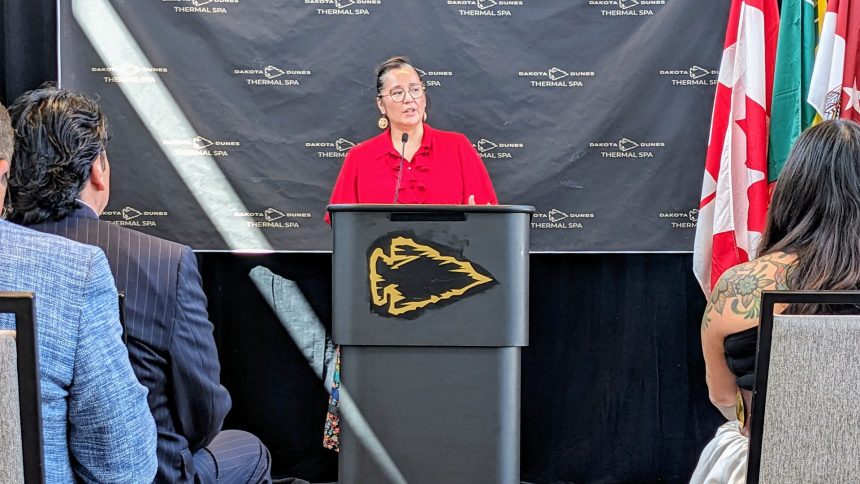
Progress on a unique virtual care facility housing technology to connect Indigenous, rural, and remote communities with healthcare services was unveiled at Whitecap Dakota First Nation Thursday. Called the Virtual Health Hub (VHH), it is located on Whitecap Dakota Nation land, 26 kilometres south of Saskatoon. The facility is the first of its kind in Canada. Indigenous Services Canada (ISC) Minister Mandy Gull-Masty was on hand to announce $5.4 million in new money for the VHH. That’s in addition to the over $28.2 million ISC has already invested toward the construction of the facility. Construction costs are being shared between federal and provincial governments with Saskatchewan providing $9.1 million, covering one-third of the facility’s construction budget. “We know that communities like Whitecap, when you give them the tools and you get out of their way, and you support their vision, they are able to take these benefits far beyond what we can envision as a government,” Gull-Masty said. Construction on the state-of-the-art building officially started in September 2025 and is due for completion in early 2027. According to the VHH website, the facility is intended to eventually serve as a national hub for virtual patient care. It uses telehealth, artificial intelligence, robotics, and other emerging technologies to bring services to communities that have long faced systemic barriers to care. A video demonstrating how robotics will be used (featured on the website) shows a pregnant woman from Stony Rapids, located more than 1,000 kilometres north of Saskatoon, undergoing a virtual ultrasound. An ultrasound technologist at the current VHH office in Saskatoon is shown employing a device remotely while a health care worker in Stony Rapids facilitates. The woman is able to see her baby on a monitor and the images can then be used for diagnostics. Gull-Masty related her personal experience with being pregnant while she was living in her home community in Quebec. “Far too many Indigenous peoples, including myself, have had to leave communities to access health care,” Gull-Masty said. “I am one of the people that also had to travel three days to receive an ultrasound when I had children. And I can really, you know, personally understand the stress that that takes. Not only having to leave your community, but to plan for the care of your other children as well as the time that you lose when you’re employed. “This is something that, you know, really spoke to me in a very personal way and resonated with me.” Travel from remote communities like Stony Rapids and Black Lake for health and other services in the south can be gruelling. While most people from those communities travel to Prince Albert or Saskatoon primarily by air via Stony Rapids Airport on carriers like Rise Air, travelers can also drive. However, the trip on the rough, unpaved Hwy 905 and seasonal winter roads heading south can take 20 to 22 hours and requires overnight stays. And it’s only available when the weather and road conditions allow. ”Families do have to travel. They have to be away from home. For elders especially, this can be very stressing. We have many elders that are traveling for medical appointments and at times are not fluent in English or French and speak a whole other language. And this is an additional, I think, source of stress for them when they’re on the road,” Gull-Masty said. Chief Darcy Bear said the use of technology at the VHH will not replace health care workers, something he said some people fear. “That’s not the case at all. We are actually empowering the health care professional to be available remotely in northern and remote communities. We’re already in 18 communities and that’s including hospitals in this province,” Bear said. “If you look at Canada, spending $400 billion in health care, but the quality of health care is going in the opposite direction…how can we deliver more effective, efficient public health care? It’s true. It’s all the remote technologies.” Bear said the VHH will not only benefit Indigenous communities, noting that an office had opened in the town of Gravelbourg, 295 kilometres south of Saskatoon. The facility at Whitecap Dakota First Nation is scheduled for completion in early 2027. Other projects underway Meanwhile, Bear also highlighted the health benefits of the Dakota Dunes Thermal Spa under construction at the resort, which is the Nation’s latest development. A golf course was the first project followed by Dakota Dunes Casino. “This whole thermal cycling, you’re seeing professional athletes today do it, you know, where they do the cold plunge and they go and they warm up again and what it does is [help] the muscle recovery, it’s good for your joints, it’s good for your sleep, it’s good for your anxiety, and also boosts your immune system,” Bear said, adding there are less than 60 such spas in Canada, Dakota Dunes may be the only one that is Indigenous themed. Gull-Masty said the $54 million spa will create 165 new jobs. “If you are looking for a career, I think there’s a path here,” she said. “There’s also 320 jobs that are being supported during the construction phase and beyond. The economic activity is not only going to strengthen the regional economy, but it’s going to create new opportunities for years to come.” The spa is slated to open Dec. 4. Read more: Whitecap First Nation on road to self-sufficiency and pulling out of Indian act – all because of a casino Continue Reading
Whitecap Dakota Nation gets new money from Ottawa for virtual health project


Leave a Comment