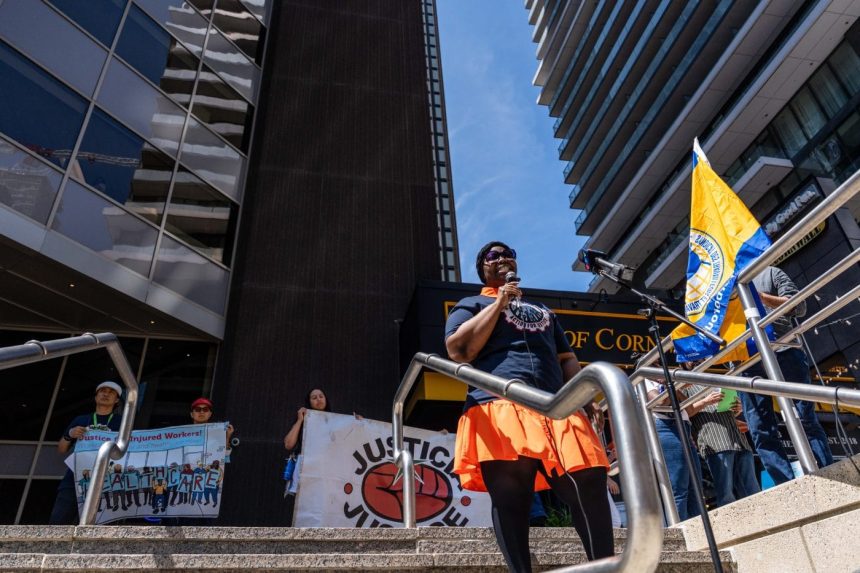
This summer, Ontarians were warned to stay inside as humidex values climbed to 48 C in parts of the province and wildfire smoke made for some of the worst air quality in the world. But many migrant farm workers were told to keep working. “I have had more than one heat stroke because there is no shade,” Alicia Anntamara, a migrant worker who is currently off due to an injury, told The Narwhal at a rally in front of Ontario’s Ministry of Labour. “You can’t take water in the field. You have no bathroom in the field.” And the heat did not necessarily end when the workday was over, she says, with no indoor spaces available to cool down. Anntamara is her middle name, as she asked to keep her surname private. Several speakers at the demonstration on July 24 says migrant workers continued labouring in fields, greenhouses, wineries and packing facilities while other residents were advised to limit their exposure to outdoor conditions. And they demanded the province fix the Temporary Foreign Worker Program, which they say brings migrant workers to Canada but fails to protect them. “There’s nothing natural about dying on the job,” Elizabeth Ha, an executive board member with the Ontario Public Service Employees Union and a member of Justice for Migrant Workers, said. “There’s nothing natural about collapsing in the fields. There’s nothing natural about working past exhaustion in extreme heat.” About 50 people gathered for the demonstration, holding signs, lining the sidewalk and chanting, “No more deaths” as they called for stronger workplace protections and access to healthcare, especially during extreme heat. Justice for Migrant Workers, an all-volunteer collective made up of current and former migrant workers, labour organizers, community activists and scholars, organized the rally. The organization says it learned through workers’ friends, co-workers and community allies that at least eight migrant agricultural workers have died across Ontario this summer. The circumstances surrounding all eight reported deaths have not been independently confirmed, and they have not all been officially classified as workplace fatalities by the provincial Workplace Safety and Insurance Board. The board told The Narwhal that from Jan. 1, 2026, to July 28, it had received less than five fatality claims involving foreign agricultural workers. The board did not provide a precise number, saying that figures below five cannot be released due to privacy considerations. Chris Ramsaroop, an organizer with Justice for Migrant Workers and an assistant professor at New College at the University of Toronto, says the group had heard three deaths were connected to transportation incidents. The group also received reports of heart-related deaths and heard concerns about whether one worker received adequate access to healthcare, he says. Chris Ramsaroop is an organizer with Justice for Migrant Workers and an assistant professor at New College at the University of Toronto. Ramsaroop says migrant worker deaths are preventable consequences of a system that puts production and profit ahead of workers’ lives. During the rally, Ramsaroop says deaths involving heart attacks, strokes and other illnesses should not be examined without considering long hours, extreme heat, chemical exposure, physically demanding labour and the stress associated with precarious immigration status. Justice for Migrant Workers calling on the province to explain whether working conditions are considered when investigating migrant worker deaths and how heat-related injuries and deaths are tracked. Ontario’s Ministry of Labour, Immigration, Training and Skills Development did not respond to The Narwhal’s requests for comment by publication time. For the rally organizers, the lack of complete information is part of the problem. They say deaths involving migrant workers can disappear from public view, particularly when workers are sent back to their home countries after becoming sick or injured. “It’s a government system that promotes production and profit over the lives of migrant workers,” Ramsaroop said. Working without water or shade Anntamara says she is learning to walk again and regain the use of her hand after suffering an injury while working in Canada. She stood in front of the crowd in downtown Toronto to speak for herself and for other workers who she says have been injured, silenced or sent home. Justice for Migrant Workers Co-Founder Chris Ramsaroop speaks outside Ontario’s labour ministry in Toronto . “We are not animals. We are not garbage. We have a name, and we come here with a name. Because you take our name and call us a number, that doesn’t make us less than human,” Anntamara told the crowd. Anntamara has been coming to Canada from Jamaica as a migrant worker since 2014. She says she was injured in July 2020 after falling more than nine feet while completing a task she had not been hired or trained to perform. She hasn’t been able to work since. As the primary breadwinner for her family, she says, her inability to work has affected her children and family who live outside Canada and depend on the money she earns here. Before her injury, she says, a typical working day could involve long hours without reliable access to drinking water, washrooms or shade. Anntamara says, after the workday, she would return to crowded bunkhouses without air conditioning or fans. Some of the accommodations are similar to shipping containers and became extremely hot in the summer and cold in the winter, she says. “When it’s hot, it’s very hot to where you see warts on your skin, like water bubbles on the skin. And when it’s cold, you’re freezing, like you’re getting frostbite,” she said. Some rooms contained up to eight beds, with so little space that workers had to turn sideways to move between them, she says. She also described working long shifts without overtime pay or regular time off. “You have to work every day. You have no day off. You have no time off,” she said. Justice for Migrant Workers says such conditions make extreme heat more dangerous because workers may be unable to cool down or recover after a physically demanding shift. The Canadian Centre for Occupational Health and Safety says working in hot environments can reduce concentration and a person’s ability to perform skilled or physical tasks. Heat also places additional demands on the heart as the body works to cool itself. Physically demanding labour generates additional body heat, further increasing the risk for people working in hot conditions. Temporary foreign worker program empowers employers According to Statistics Canada, more than 30,000 migrant agricultural workers were employed under Canada’s Temporary Foreign Worker Program in Ontario last year. Workers are hired from dozens of countries, but the majority come from Mexico, Guatemala and Jamaica, thanks to agreements with those governments.
Working past exhaustion in extreme heat: migrant farm workers rally in Toronto