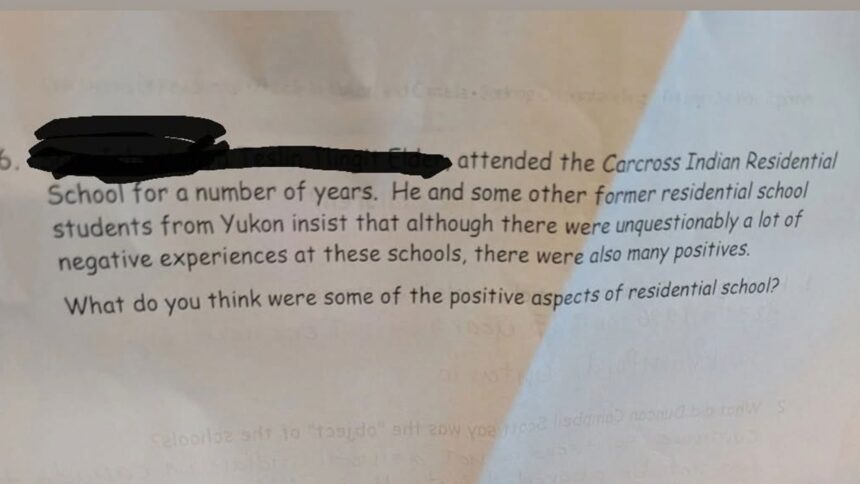
A worksheet asking high school students in Whitehorse to identify the positives of residential schools has attracted public criticism, prompting the Yukon Department of Education to commit to a curriculum review. A photo of the worksheet was circulated on social media late last month. The department confirmed in an email to APTN News that the worksheet was part of a Grade 10 teaching resource made available to Yukon schools in October 2024. The person who shared the photo declined to speak with APTN, but said it came from a high school assignment at a Whitehorse school. The worksheet includes two experiences shared by residential school survivors whose names are blacked out. One question asks how some survivors, like one who attended the Carcross residential school, “insist that although there were unquestionably a lot of negative experiences at these schools, there were also many positives. What do you think were some of the positive aspects of residential school?” Another question quotes a survivor from the Northwest Territories and asks: “To what extent do you think the positive parts of Indian residential school need to be part of what people learn about?” The questions came as a shock to Francis van Kessel, who is Teslin Tlingit. “I don’t think we talk about the Holocaust in a positive way because we shouldn’t. So why are we talking about residential schools in a positive [way]?” she said. van Kessel said her mother and grandmother attended residential school, the wounds of which continue to impact her and her family. She described the questions as insensitive and dismissive of survivor’s experiences, prompting her to write a seven-page letter to the territory’s education minister demanding the questions be removed, a review of how residential school material is taught and mandatory professional development for educators, among other things. “There’s no positives in genocide,” she said. “This brought up a lot of emotion for myself, so I’m sure it brings up a lot of emotion in other people. This isn’t the way to teach children about history.” Francis van Kessel, a descendant of residential school survivors, says she’s hurt by the questions and found them offensive. Photo: Jordan Haslbeck Yukon NDP MLA and education critic Linda Moen said the questions minimize the harms of residential schools. She raised her concern with the document in the legislature this month, arguing the questions echo residential school denialism. “First thing I thought was the lack of empathy, lack of compassion. I think we’re just not there yet as Yukoners and Canadians to start discussing if there were any positive aspects to residential school,” she said. A Kwanlin Dün First Nation citizen and the daughter of a residential school survivor, she said the questions hit close to home. “That’s not the narrative that I was given through my entire lifetime, so when I see people being taught in school—schools are there to educate. So, let’s educate the truth,” she said. Yukon NDP MLA and education critic Linda Moen says the broader community isn’t ready to discuss the positives of residential schools. Photo: Submitted by the Yukon NDP Melanie Bennett, executive director of the Yukon First Nation Education Directorate (YFNED), said in a statement that the worksheet is a curriculum document that was used as a guide by a Yukon teacher and was “developed with First Nations approval.” She said that a small number of Elders have shared positive experiences, which were quoted in the document, but warned that “by no means should these rare experiences provide justification for an argument that there were ‘some positive aspects of residential schools’ to quote the school test under scrutiny.” “YFNED urges educators to not weigh the pros and cons side-by side, equally,” she said. “The overall negative impact of Residential Schools is so completely negative, attempting to destroy language, culture and families, that even if a child experienced loving care or positive educational experiences at residential school, they were still victims of this wholly negative attempt at cultural genocide.” Survivor says there’s room for nuance But for Joanne Henry, a residential school survivor and the executive director of the Committee on Abuse in Residential Schools (CAIRS), which helped develop the curriculum on residential schools, the question deserves nuance. She said the curriculum was designed to pair classroom discussions with survivors’ stories. Henry said that in some cases, survivors might choose to share positive experiences — something she believes is their right. “That doesn’t mean it’s a good experience for everybody. It just means that individual who made that comment — and his name was marked out — that just means it was good for him. He doesn’t speak for everybody,” she said. “I don’t see anything wrong with it.” Still, she agrees that negative experiences overwhelmingly outweigh the positive ones some survivors may have had. “I don’t think it minimizes residential school. I don’t think it takes away from the horrific stories. They’re always going to be there. They’re not going to go away,” Henry said. Joanne Henry, a residential school survivor and the executive director of the Committee on Abuse in Residential Schools (CAIRS), says the negatives of residential schools far outweigh the positives. However, she says survivors might have had positive experiences within the residential school system. Photo: Jordan Haslbeck/APTN News Yukon to review residential school curriculum The Department of Education said in a statement to APTN that it doesn’t track which schools or teachers used the document, nor could it provide a reliable estimate of how many students completed the specific activity. Education Minister Scott Kent said the document is part of residential school curriculum developed in 2018 in collaboration with the Yukon First Nations curriculum working group, which included Yukon First Nations Elders, knowledge holders and local perspectives. He said the department will launch a review of the curriculum to see whether changes are needed, including how the document is used. “Rather than maybe just sending that as a question for students to take home and have homework, maybe a group discussion or something like that,” he said. Education Minister Scott Kent says the department will launch a review of the curriculum to see whether changes are needed, including how the document is used. Photo: Jordan Haslbeck/APTN News Speaking at the Yukon Legislative Assembly on Nov. 23, Kent said that the department will work with the working group on the review. “I believe that, in order to be respectful, we have to allow those individuals who developed it in the first place to make a determination on whether or not it is still appropriate and meeting the needs of our students,” he said. He also noted that two “highly trained, qualified, and experienced First Nations curriculum consultants within the department” led the work to create the document, and that educators teaching it receive two days of training led by First Nations curriculum consultants involving an Elder, knowledge-keeper or residential school survivor. “Acknowledging the varied personal experiences shared by survivors is not the same as describing residential schools as positive institutions,” he said. “The teaching resource is clear that the harms of the residential school system far outweighed any positive experiences reported by individual survivors.” Kent said there’s no timeline yet for the review. Sara ConnorsReporter | WhitehorseSara Connors is originally from Nova Scotia and has a journalism degree from the University of King’s College in Halifax. After graduation she worked in South Korea for two years as an English language teacher and freelance journalist. After she returned home in 2019 she worked behind the scenes at CTV Atlantic in Halifax before joining APTN’s Yukon bureau in July 2020. Continue Reading
Yukon to review worksheet asking students about positives of residential school


Leave a Comment