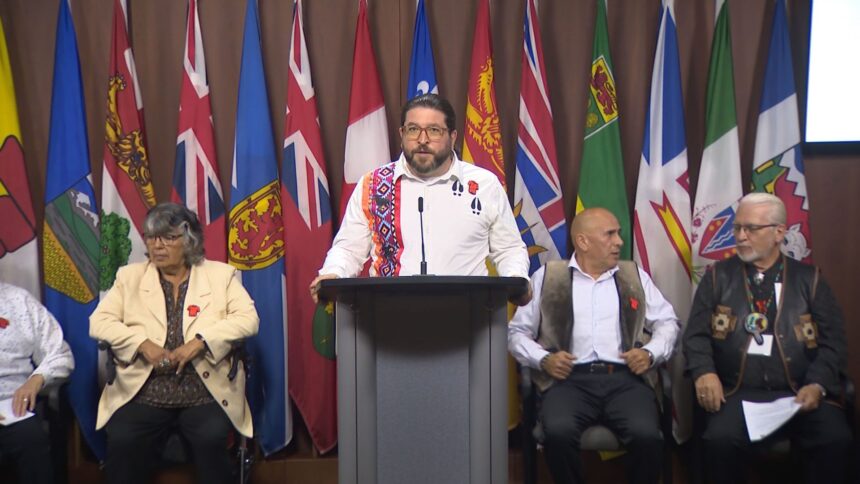
The Congress of Aboriginal Peoples (CAP) says the federal government has unilaterally ended the Canada-CAP Political Accord and cut about $3 million a year in funding with no notice — a move National Chief Brendan Moore says has already damaged the organization’s ability to do policy work. Moore spoke after CAP supporters marched on Parliament Hill to protest what the organization called the “Government of Canada’s unilateral decision to end the Canada-CAP Political Accord.” The 2018 accord was signed under former prime minister Justin Trudeau after the Supreme Court of Canada’s 2016 Daniels decision, which confirmed that Métis and non-status Indians fall under federal jurisdiction. CAP, founded in the 1970s, is one of five national Indigenous organizations recognized by Ottawa and says it represents Métis, status and non-status First Nations people, and southern Inuit living off reserve. “Canada has terminated its participation in the Canada-CAP Political Accord. There was no consultation with us. There was no replacement mechanism offered,” Moore said. He said the cut landed all at once. “It does really damage our capacity to do policy work,” he said. “For the first time in the history of CAP we never qualified for the Federal Interlocutor’s Contribution Program.” Moore, left, marching with supporters on Parliament Hill. Photo: Keelan Jacobs/APTN. Moore said missing and murdered Indigenous women and girls work was hit as well. “We’ve seen our funding for missing and murdered Indigenous women be reduced by 40 per cent. It’s been a massive hit to our national organization.” Much of the accord money, he said, flowed to CAP’s provincial and territorial organizations so they could do their own policy work. Moore told reporters that earlier this year, CAP received a letter from Crown-Indigenous Relations (CIR) Minister Rebecca Alty saying the department was working on a multi-year agreement. Instead, Ottawa came back and ended both the accord and the funding “effective immediately.” “Today’s march was not the end. It was the beginning,” Moore said. Asked about the Carney government’s approach, Moore said Ottawa “seems to be deeply committed to the distinctions-based approach,” and that approach leaves off-reserve and non-status people behind — including in emergencies, health care and urban services. “Ten years after Daniels, we have to ask: where are the programs?” he said. Other CAP leaders and constituents echoed that the cut reaches people who never lived on reserve. “This decision strips away the urban protections that Harry Daniels fought for,” said Vice-Chief Randy Way, a Métis leader. National youth representative, a Mi’kmaw youth from Nova Scotia, said the accord’s end was felt immediately. “When the political accord got cut, I felt something change,” she said. “Does every child really matter?” CAP supporters marching on Parliament Hill on Friday. Photo: Keelan Jacobs/APTN. Mary Palmater, a status First Nations woman and CAP’s national elder representative who has lived off reserve, said she has been a CAP member for 53 years and is fighting for “rights of all off-reserve Indigenous people.” APTN News reached out to CIR on Friday to ask about the cut. “Activities related to the political accord agreement with the Congress of Aboriginal Peoples were supported by a funding agreement that has also now concluded,” Alec Wilson, senior communications advisor and press secretary to Alty said. “Federal programs and services, including the Federal Interlocutor’s Contribution Program, the Urban Programming for Indigenous Peoples program, and the Indigenous Skills and Employment Training Program, remain available to support eligible individuals and organisations.” Moore rejected the idea that remaining programs replace the accord. He said CAP, for the first time in its history, did not qualify for the interlocutor program, and he called on the Carney government to sit down, find a new engagement mechanism and stop what he described as the erasure of off-reserve voices. “We’re not going to go away,” he said. “Nothing about us without us.” The Canada-CAP Political Accord was first signed in 1994, when CAP became the first national Indigenous organization to formalize that kind of relationship with Ottawa. It was renewed in 1998 and 2005, then again in 2018 as a response to Daniels. CAP has said the accord was the vehicle for jointly agreed policy priorities, including implementation of the court ruling and work on missing and murdered Indigenous women and girls. Continue Reading
CAP national chief says $3M cut of federal money came without notice



Leave a Comment