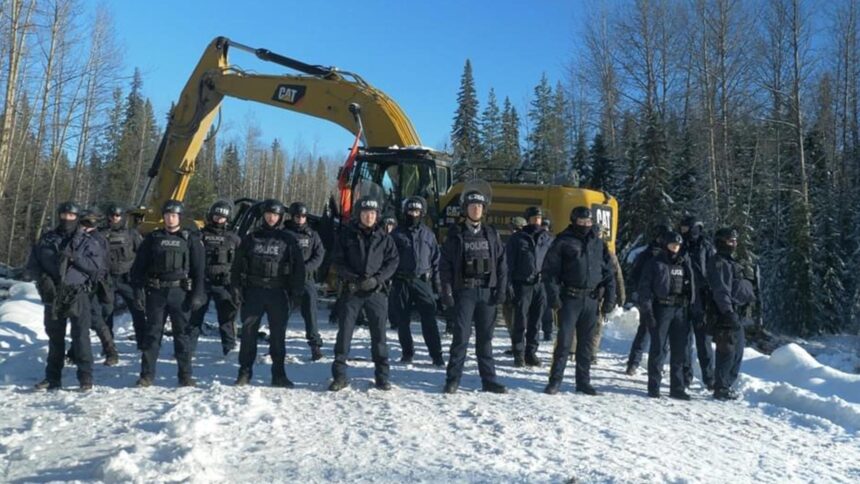
A federal watchdog is postponing the release of its report on the RCMP’s specialized protest response unit in British Columbia. The new report by the Civilian Review and Complaints Commission (CRCC) into the Critical Response Unit BC (CRU-BC), was to be released Wednesday, but the agency said it won’t be released until after the B.C. provincial election, called Tuesday by Premier David Eby. “During an election period, the provincial government operates under caretaker conventions, which limit its ability to address or respond to matters that could be viewed as involving policy, administration, or future government decision-making. Publishing the report while the province is in caretaker mode would therefore make it difficult for the relevant provincial authorities to fully consider and respond to its findings and recommendations,” said an email from the CRCC. “To ensure the report receives appropriate consideration and to avoid any perception of interference in the election period, we have decided to delay publication until a new government has been sworn in and normal government operations have resumed.” CRU-BC is the new name for the Community-Industry Response Group, or C-IRG, which the RCMP adopted in 2024. The CRCC is a federal agency, separate from the RCMP, that investigates complaints from the public about the conduct of the Mounties. According to its website, the agency “conducts reviews when complainants are not satisfied with the RCMP’s handling of their complaints.” The agency shared an embargoed copy of the report with APTN News after the network agreed “not to publish any information from this report until its official release.” At least one other network agreed to the same terms, which is common with upcoming reports. Advance copies allow news outlets to analyse a report prior to its release. The CRCC initiated the systemic investigation after receiving more than 500 public complaints, as well as letters from civil liberties groups, Indigenous organizations, interested parties and people directly impacted, according to a statement from the agency in March. The C-IRG was established by the B.C. RCMP in 2017 to address the increasing number of protests related to resource-based development projects, such as pipelines and logging operations. Its primary purpose was “intended to provide strategic oversight in addressing energy industry (gas and oil pipeline) incidents and related public order, national security and crime issues. Its mandate was to ensure a consistent, standardized and impartially administered police response across the province, using a measured approach in facilitating the peaceful resolution of public order issues,” according to the RCMP website. The C-IRG’s operations on Wet’suwet’en territory in 2020 prompted backlash and countrywide protests like this one in Ottawa. Photo: APTN ‘Bewildering’ The president of the Canadian Association of Journalists (CAJ), an organization that represents journalists in Canada, called the decision to withhold the report until after the election “bewildering.” “C-IRG has been the subject of intense scrutiny from the public and press freedom advocates for many years due to its repeated use of so-called ‘exclusion zones’ during demonstrations over the development of natural resource projects in Wet’suwet’en territory and Fairy Creek. These tactics have been deemed to have caused “serious interference” with press freedoms,” Brent Jolly said. Jolly said an election shouldn’t be a reason not to release the report. “As an independent watchdog, however, it appears the CRCC is making what amounts to a political decision by withholding this report. The public’s right to know is a fundamental principle of a free and democratic society. Transparency matters because accountability depends on the public having access to information about decisions, institutions, and matters of legitimate public concern. “Withholding this report today hurts the public’s ability to receive a dispassionate analysis about the conduct of agencies funded by taxpayer dollars and, ultimately, to hold power to account,” he said. According to an update on the status of C-IRG-related public complaints and reviews (as of March 1, 2026) on the CRCC website, of the 572 public complaints received by the CRCC, only 123 met the complaint criteria laid out in section 45.53 of the Royal Canadian Mounted Police Act. The CRCC said that most of the refused complaints were from individuals who were not physically present at the three sites. A civil trial against the RCMP is underway in B.C. Supreme Court. Photojournalist Amber Bracken was working for The Narwhal when she was arrested in 2021. Photo: APTN file Prior case on C-IRG exclusion zones heard by B.C. Supreme Court The British Columbia Supreme Court (BCSC) ruled on the legality of the RCMP’s exclusion zones and checkpoints during the Fairy Creek protests in August 2021. According to the CRCC website, C-IRG conduct at Fairy Creek was one of the areas the report examined, APTN can report. Similar issues have arisen from other protests, including ones on Wet’suwet’en Territory. Journalist Amber Bracken and the online publication The Narwhal are suing the RCMP after she was arrested during a raid on a land defender’s camp on Wet’suwet’en Territory in 2021. According to The Narwhal, “RCMP officers breached a locked tiny house on Wet’suwet’en territory with an axe and chainsaw…As police moved in to arrest the people inside, photojournalist Amber Bracken was present documenting — until she was arrested herself. Bracken was “handcuffed, held in a cell for three nights and had her camera gear and photographs seized.” “We were documenting issues of broad public interest, including the injunctions granted by Canadian courts that restrict public movement on behalf of private corporations — and how publicly funded police act when enforcing them,” The Narwhal said. Read More: Behind the Thin Blue Line: Meet a secretive arm of the RCMP in B.C. According to the CAJ, Bracken was “out in the field, documenting tensions over the construction of the Coastal GasLink pipeline through unceded Wet’suwet’en territory.” The RCMP claimed she was allegedly “aiding or abetting” protesters on site and “not engaged in good-faith newsgathering activities.” Currently, both parties are waiting for the judge’s final decision. Election day in British Columbia is Oct. 24. Continue Reading
Federal agency postpones release of report on B.C. RCMP until after election


Leave a Comment