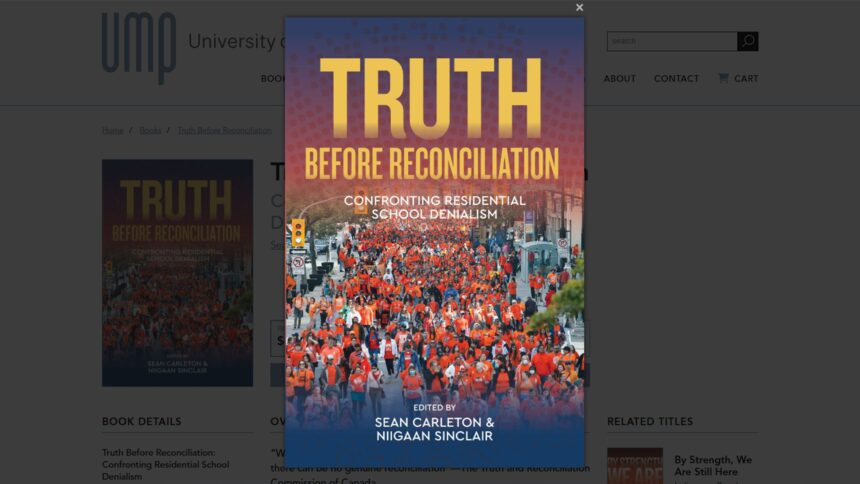
The authors of a new book on residential schools and reconciliation say that while the number of denialists in Canada isn’t growing, social media is helping amplify the voices of a small few. “I think sometimes it may feel as though there is a rise in denialism, or residential school denialism,” Niigaan Sinclair, professor at the University of Manitoba in Winnipeg and co-author of the book Truth Before Reconciliation, Confronting Residential School Denialism, told InFocus guest host Dennis Ward. “But I think what we’re seeing is 150 years of Canadians who have been misinformed or miseducated on the issues, everything involving indigenous peoples, but particularly on the issue of residential school.” Sinclair described the driving force in discussions that question the facts about residential schools as a small group of people with loud voices seeking to prey on misinformation and ignorance. “There is a wave of individuals who would like to profit off those who are perhaps uncomfortable, or uncertain, or have some doubt as to whether this is a project that’s the most important in the country, which it is,” he said. The title of the book is based on comments made by Sinclair’s father, the late Murray Sinclair, chair of the Truth and Reconciliation Commission (TRC). Along with his co-commissioners, Murray Sinclair and the TRC crossed the country and heard from thousands of witnesses about their experiences in residential schools, which operated for about 150 years. The goal of the institutions was to assimilate Indigenous children into non-Indigenous society by removing their culture. Many survivors spoke about the abuses they suffered. The TRC also unearthed information about unmarked graves at schools across the country. According to TRC’s Final Report, released in 2016, more than 4,000 children never came home. In 2021, Tk̓emlúps te Secwépemc announced that a “mass grave” of 215 children had been discovered at the former Kamloops Indian Residential School. The language used by the community and the media to describe that discovery changed shortly after. What had been found were “anomalies” located by ground penetrating radar and other tools. Residential school denialists jumped on the uncertainties in the language used to discuss the discovery. “The issue, to Niigaan’s point, is that it [denialism] is still being consumed by a lot of folks that are not necessarily informed about Indigenous issues,” said the book’s co-author Sean Carleton, also a professor at the University of Manitoba in Winnipeg. “They don’t have Indigenous people in their lives. They are easily susceptible to many of these already debunked talking points, [like] ‘Residential school was well-intentioned. It was of the times. There was no criticism. Abuses are being exaggerated: there were no deaths, or deaths were unavoidable.’” Carleton argued that those who don’t know Indigenous people or haven’t read the TRC’s Final Report can be easily swayed by such arguments, which suggest that “You’re being ‘guilted into caring about Indigenous people and reconciliation when you don’t know the facts.’” He added that toward the end of Murray Sinclair’s life, he discussed the feeling that Canada was rushing reconciliation but leaving the truth behind. “It was a warning,” he argued, “to say, ‘We need to put truth before reconciliation. We need to learn the truth first, and invite as many people into that transformative process as possible.’ And so we’re at the crossroads. I think we need to double down on putting truth before reconciliation and do that hard learning so that we can not be distracted and derailed in our progress and continue to build better relationships for the future.” Truth Before Reconciliation features several chapters with contributors telling their stories. Phyllis Webstad is one of the. Webstad started the Orange Shirt Day movement that is marked on Sept. 30 each year. “To tell the story of residential school you need to have first hand the survivors of the schools,” Niigaan Sinclair said. “We have those who were directly impacted by the schools. Those who are members of our families and our communities. That’s people like myself and many intergenerational survivors that exist in the book. “This book that we have is peer-reviewed, unlike other books that have been produced denying residential schools or performing denialism. There’s no peer review to that. In fact, it’s just a bunch of social media posts that have absolutely nobody checking in whatsoever, in any research or anyone who has any credentials. They have no responsibility to anybody.” Niigaan Sinclair offered Truth Before Reconciliation to non-Indigenous readers as “a tool to inoculate themselves from what is an ongoing epidemic of ignorance in this country.” “Every Canadian was miseducated or misinformed about Indigenous peoples overall, but particularly around residential schools,” he said. “When there’s individuals who are trying to sow on that ignorance or try to wedge Indigenous peoples and Canadians against each other, and trying to monetize that and sitting in a basement making a website to try to profit, we need to combat that. According to Carleton, each chapter of the book offers “original insight and ways into understanding both the established record of Indigenous experience, but also the way in which denialists try to undermine that.” “For example,” he said, “I’m a historian. I’m not an archeologist or an anthropologist. Andrew Martindale’s chapter walking us through how ground-penetrating radar works, what the technology can find, what it can’t find, how it needs to be used in combination with other kinds of research tools was fascinating. “I think if more Canadians could sit and read this, they would understand, ‘Oh, ground-penetrating radar doesn’t detect remains. But it can be used in combination with all of these other tools to identify areas of interest, and can help show patterns that make it clear that we need to continue to do this work in this moment.’” Another day, another totally normal response to @niigaanwewidam.bsky.social and my’s new edited book, Truth Before Reconciliation: Confronting Residential School Denialism, featuring a dream team of collaborators and subject experts dissecting the unhinged racism/misinformation. pic.twitter.com/vhP1V3OS5J — Sean Carleton (@SeanCarleton) September 23, 2026 Likewise, he said, the first-person voices of those who survived residentials schools only to face denialism are eye-opening. “Just talking with Phyllis Webstad to kick off the book about the kinds of unhinged racism that she faces daily from these folks,” he said. “Emails, social media, just the kind of hatred that exists in this country towards Indigenous people, survivors in particular, as a way of de-legitimizing them to try and resolve some of that cognitive dissonance that Niigaan is talking about of ‘Canada, the good, the benevolent,’ versus the genocidal origins and ongoing ramifications of this country for Indigenous people.” Asked if Canada is further ahead than in 2016 when the TRC report was published, Niigaan Sinclair said, “absolutely.” “We are at the most progressive moment in history,” he argued. “It may not always feel like that. We see wildfires disproportionately impacting Indigenous peoples. Many of our relatives are still in poverty, in the child welfare system, [or the] justice system, more than anyone else. “We may feel to ourselves that after a progressive prime minister [Justin Trudeau] comes a prime minister [Mark Carney] that wants to bulldoze through Indigenous rights when it comes to building resource projects… but if you actually look around, look in every workplace, from Ontario, west, what you have is an Indigenous professional in almost every single workplace.” Read More: Denialism close-up: APTN Investigates captures Frances Widdowson’s surge He noted that at the University of Manitoba, where he and Carleton work, there are 3,284 First Nations, Inuit and Métis first-year students, comprising the largest on-campus Indigenous community in history. “You have more indigenous peoples who are working with Canadians, and on top of that, you have Canadians who are taking more courses,” he said. “They’re learning at a younger level. “We’re in unprecedented times. We’re operating without a net, and we’re probably going to slip. We’re probably going to fall. We’re probably going to injure ourselves occasionally in this journey. But most importantly is we are headed in the best direction that we’ve ever been in today. I know it doesn’t always feel that way, but that’s the fact, is more people than ever are capable of working together.” Listen to the InFocus episode about the book Truth Before Reconciliation: Continue Reading
Were in unprecedented times: Authors of Truth Before Reconciliation join InFocus to discuss the future

Leave a Comment