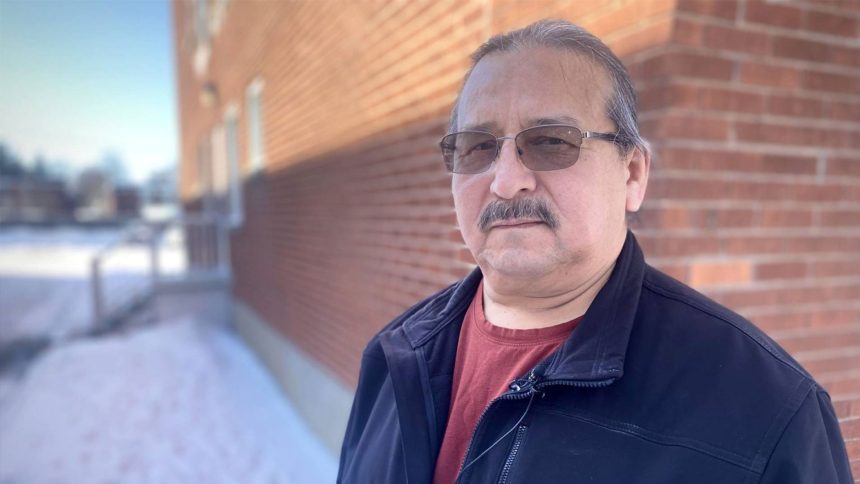
Hazel Kent has been waiting for her brother, Daryle, to return home to Brokenhead First Nation for seven years. The 63-year-old is currently in a halfway house near Brampton, Ont., but was originally approved for day parole in 2021. The home is completely ready for him. Curfew is in order, what family is left is ready to support him, and the bed is made. But Hazel is still waiting. Despite being the one who’s going to be looking after him, she said she still isn’t sure why he isn’t home and no one is reaching out to tell her. “I had one, two visits from the Winnipeg parole office,” Hazel said. “Daryle said he wanted to apply to come home, and he does this every year or every two years to see if he can come home. And I’ve been advocating for him non-stop through the years. There were a few years during COVID [where] I gave up, but yeah, we started in 2018.” She said that although she has always advocated the cause with vigor, the urgency ramped up over a year ago, when Daryle called to tell her he had stage four liver cancer. “That spurred us on,” Hazel said. “When he called and said he was in the hospital, very sick … We’re like, ‘oh no, what are we going to do?’ So, we start pushing harder. Went to the chief and council, and they supported me and my family.” “Everything was looking great, that he was coming home,” she said. “Then it spurred on the probation officer coming and checking my house. He even gave me a piece of paper saying it would be Daryle’s halfway house, basically, and that I would have to keep tabs on him. And I thought okay, good, he’s coming.” However, that day never came. “That never happened, a year and a half ago. Here we are now, and he’s still being refused to come,” she said. Instead, he received a six month extension in a halfway house, located in the Brampton area. To her chagrin, he wasn’t even on day parole anymore, and hadn’t been since February 2025, around when she was last expecting him. This was news to Hazel: “I said, ‘what the heck?’” The most recent decision, dated May 5, 2026, is still on her fridge. According to the parole board, the decision to “day parole other,” or DPO, would “afford [Daryle] the opportunity to return to your home community where you can address your deteriorating health issues and access resources (including traditional medicine) to address your terminal diagnosis.” However, the board stated, “in deciding whether to grant parole, the protection of society is the Board’s paramount consideration.” It continued that, in Daryle’s view, “the Board denied you day parole to another location (DPO) arising from a combination of erroneous information and an unfair risk assessment,” which included: “The Board’s excessive reliance on the circumstances of your day parole suspension in February 2025 which you believe are partial truths and fabrications created by CSC [Correctional Services Canada], an organization you state cannot be trusted to produce fair reports; “The Board’s finding that you breached your conditions of release and its use of your criminal history which you argue is not an ‘indicator’ given the passage of time;” and “Your view that the CBRF [Community-based residential facility] did not provide you with support beyond a place to sleep, that you are being forced to move to a different CBRF away from your home community, and that your day parole to another location is opposed by CSC because of your liver cancer diagnosis.” The board concluded that, with respect to the current circumstances, an extension would be appropriate. “The Board agreed with CSC that you have not demonstrated, at this time, the stability and progress required to be supported for [DFO]” “Another six months of stability. I go, ‘what?’” Hazel said. Her brother, on the other hand, wasn’t surprised. During a phone interview with APTN News a few weeks later, Daryle, who is out of the hospital but terminal, is far more cynical. “They will never allow me to go home. Never,” he said. “They will never allow it. They are hoping that my condition gets worse, so that I will die and then they will be rid of me. “Some of them will be happy and smile, some will probably celebrate away from prying eyes and ears. And I’ve accepted that as the reality based on the facts of my situation and history.” This particular history is well-documented, and despite the extremity of Daryle’s own situation, he believes it’s common, hence his reaching out to APTN. “I hope that a lot of this can be exposed in some form or another,” he said. “I don’t expect them to let me go home. I don’t expect them to treat me justly. I expect to be treated vindictively if I do win anything, the premise of returning home. And if I do return home, I expect to be met on the highway somewhere by RCMP… And for some reason they’ll say, ‘he pulled a weapon.’ And that’s what I expect. The strange thing about it is though, it doesn’t scare me.” A complicated history Stony Mountain Institution, a multi-security prison near Winnipeg, Manitoba. Photo: Emma Honeybun/APTN News. To properly understand Daryle’s experience, plight and the severity with which the parole board has approached his case, we first need to go back to the 1980s. In March 1984, he was convicted of armed robbery and sentenced to three years. While serving time in Stony Mountain Institution, he was involved in a riot where two living unit officers, Werner Rudolph Friesen and Joseph George Wendl, were killed. Friesen and Wendl were overtaken and grabbed by four men while locking cells, which is when they were stabbed. Both of them left behind young children. Daryle was originally charged with two counts of first-degree murder. One of those charges was downgraded to manslaughter. Daryle served 38 years in different federal prisons, including the Special Handling Unit (SHU) in Quebec. Daryle said he did not stab the two men, but does not deny his involvement. He was 21 at the time. Werner Rudolph Friesen and Joseph George Wendl were fatally stabbed during a prison riot in 1984, each leaving behind young children. Photo: Corrections Museum of Manitoba. Daryle’s maximum security sentence was reduced to medium in 2006, and he was granted Escorted Temporary Absence by Correctional Service of Canada (CSC) in 2017. This gave him the capability to leave prison on a supervised basis, which is when he began asking to go home. He was approved for day parole in 2021, although it was not in Manitoba. Specifically, a 100 kilometre radius around the most northern point of Ottawa. He broke this parole restriction in 2025, and is now in a halfway house in the Brampton area, northwest of Toronto. As Daryle mentioned, he applied to go home every few years, but was denied due to several factors, which include but are not limited to prior parole violations, the location of the victims’ families, and an ex-girlfriend he describes as “a crusader.” In the board’s own words, “it is the case that you [Daryle] engaged in very serious behaviours that resulted in the loss of two lives and must be under scrutiny as you reintegrate into society. “Your day parole has been quite chequered, with two suspensions in 2023 and 2025. You have demonstrated some difficulty in following the directions of various supervising officers, have struggled with transparency, have presented with concerns regarding accountability, and struggles abiding your special conditions. There are also concerns about the proximity of your proposed [DPO] location to where the deceased victims lived and worked, which would traumatize their families, loved ones, co-workers and the community.” Daryle argues he isn’t violent, but rather an “old man,” dealing with an illness. As well, in the case of his most recent parole suspension, the 100 kilometre restriction was only broken when his ex-girlfriend drove him out of the area during an argument, which is detailed in the decision. “I didn’t do anything wrong,” Daryle mused. “I broke the rules.” Although, he said, it wasn’t his own doing. He said that’s been the part of his case that’s been draining him the most, recently. “I know it’s unfair, but I don’t have a voice,” he continued. “I don’t have a voice in the authority, and the people within the system … but the bottom line is, I didn’t do anything wrong. And I’d like to hear them… and I’ve asked, tell me what I did wrong. The only thing they could do is cite fabricated claims that they made to get me locked up. And then I presented to them, their own document, this showed that I did not violate those rules they claim I did, but then they … have to stick together. “So the parole board is complicit with [CSC] in maintaining the delusion that I did something wrong?” he said. Prior to his time at Stony Mountain, Daryle, who is Ojibway, spent time in juvenile detention, beginning with time in the Manitoba Youth Centre following a fight in Winnipeg when he was 13. His violent behaviours as a teen were partly caused by him being taken from his family during the Sixties Scoop. He also dealt with racism throughout his childhood, he noted, which started his habit of fighting. He said he lived on a farm for a few years, where he was beaten regularly by one of the older boys who lived there. He was also held in Headingley Correctional Institution, a provincial jail in Manitoba west of Winnipeg, for nine months when he was 17. He was facing attempted murder charges but was released without a trial, he said, because he wasn’t present when the shooting in question. Daryle (pictured) was 21 when he took part in a riot that killed two corrections workers in 1984. He said he never stabbed anyone, but has never denied his role in the incident. Photo: supplied. Daryle said he believes the corrections system means to “disappear him.” “I’ve always had to deal with unfair treatment, injustice, if you want to call it that, from authority figures, the police especially, and then [CSC],” he said. “It’s systemic, the way they treated me, and Indian people in general. That was the very definition of systemic racism. It’s just commonplace that they themselves don’t see it as racism. It’s just the way things are. “And that’s the way things were done then [while I was a teenager],” Daryle continued. “And they still are, but now it can be identified. But those who identify it as discrimination and racism, injustice, are shunned, silenced and ridiculed. So the people that work within the system who speak out against it are silenced by those who commit these actions.” Access to familial support a public interest: Pate Daryle is one of several Indigenous offenders who have had ongoing discussions with Canadian Sen. Kim Pate, regarding having their cases re-examined. Before being appointed to the Senate, Pate was the executive director of the Association of Elizabeth Fry Societies, a prison advocacy group for women. She continues to advocate for prisoners. Although she could not speak specifically to Daryle’s case in great detail, she could speak to much of the context around it. “The law applies equally to everybody, and that everybody gets a fair trial, a fair process, and that certainly is the law,” she said. “The reality is, though, the reason that our jails are full of the people who are failed by every other system, is because the more inequity, the more discrimination, the more intersections of discrimination apply to an individual … the more likely it is that we’ll see someone not end up having the kind of trial we might expect would be available to everybody based on the law.” Sen. Kim Pate reads a letter from an incarcerated person in her Ottawa office in 2023. Photo: APTN File. Pate said Indigenous Peoples have a much higher chance of being the subject of these inequities, due to trauma caused by colonialism and residential schools causing issues such as disabilities, poverty, and other factors which may make their trial more difficult. She also said that, no matter how “excellent” resources like legal aid can be, they’re often overwhelmed, and courts are “jam-packed.” As a result, many cases don’t result in a trial if the subject has already pleaded guilty, no matter why they may be making that plea. When asked about how a move back to a home community would benefit an Indigenous offender in Daryle’s situation, who is being encouraged to stabilize, Pate said having access to traditional, familial, and community supports “is vitally important. “The government’s own research in this shows that the more someone has community support, and particularly family support, and things like a place to live, activities, whether it be healing activities or therapy or work to occupy their time and something that is meaningful to them, those are the three keys to successful community integration,” she said. “And when you think about it, it’s also the key to why some folks have not been integrated in the first place, and have contributed to them being criminalized and imprisoned,” Pate added, “because not everybody has access to that kind of support to start with. We see that especially right now as we’re seeing growing numbers of homeless people, people living in poverty and not having community and employment and education, those sorts of things. So it’s vitally important.” She said that access to those supports is in the public interest, as well. “Not just for Mr. Kent, but for many, many others and everybody,” Pate said. “I mean, why wouldn’t we want people to be included in the community? And when we look at countries in particular or areas where the focus is on meeting the needs of individuals, ensuring that nobody is left behind, that nobody is left living in poverty, on the streets and homeless, with addictions, with mental health issues unmet, then those countries and communities … We know that people do better. They’re less likely to be victimized, they’re less likely to be criminalized, and they’re less likely to be imprisoned and more likely to be integrated into the community, and why wouldn’t we want that?” Photos of a cramped Special Handling Unit (SHU) cell, taken in 2022. The ‘supermax’ prison in Quebec is one of many which held Daryle during the 38 years he spent incarcerated. Photo: APTN File. Still waiting Brokenhead First Nation remains ready for Daryle should he ever be approved to come home. Although, due to the Sixties Scoop, it’s a home he’s never really lived in. According to Brokenhead’s Chief, the community “has cultural support” ready for Daryle and the community is ready to welcome him. He and council have met with Hazel to discuss work, curfew and their ongoing collaboration with the Southern Chief Organization (SCO)’s legal team. Hazel said the community was also able to raise approximately $5,000 to afford cancer treatment equipment for Daryle if he were to return home. However, her uncertainty increases with each passing year. “Here we are today, still waiting,” she said. “We’re not the same people that we were 48 years ago,” she continued. “You know, Daryle is following our traditional way over there. His Elders. And then nothing. It’s been quiet now. He tried to appeal, because we talked, he said, ‘Should I appeal the hold for six months?’ And I go, ‘I don’t know, Daryle. You know, I’m getting tired and I’m getting old.’ And then he said he wasn’t going to do it. Daryle eventually changed his mind for documentation purposes and is awaiting a result. “They’ve always used these catchphrases, until he settled down, until things settled down, and I was like, What? The community? Him? I don’t know,” Hazel said. “And the reserve is a reserve. It’s a living, breathing community. It’s like a municipality; you can’t go down the street and tell people, you’re affecting my brother coming home, smarten up! As long as I keep my home safe and secure and the people around it are supporting him, what more can we do? “I’m at the end of the road. Why would they keep my little brother away from us? You know? Because of a terrible thing that happened [in 1984]. So, I’m still fighting, but it’s exhausting,” she said. Although Daryle believes he won’t go home, he’s continuing to advocate. “I don’t allow it to make me any weaker,” he said. “It only makes me stronger, more determined to expose the mentality of who these people are and what they’re all about. And this goes back into history. I relate a lot of my experiences to history. I don’t pretend to be anybody of great importance in society. I’m just another human being.” He cites Crazy Horse as an example of keeping one’s word. “I’m keeping my word. I’m staying out of trouble and paying the rules and following the instructions. But they will not, they will not do anything to honor any of the policies,” he said. “I’m not a threat to society. I didn’t attack society … What about my people? What about me? What about my experiences with this very system from childhood to adulthood today, to today, where injustice is, and it’s proven, injustice has been committed against me and my people collectively and individually. And again, it’s the very people who are making these determinations about me are the very people who are responsible for the injustices that have been done against my people. And me. Individually.” He said he still speaks to his family and his sister, but it’s impersonal. “And I still would love to be home and just be home. That is my home, my people,” he said. “CSC doesn’t want to be back there. They want to continue the punishment because I’m dead.” In a statement sent to APTN, a spokesperson for CSC said that “protecting the safety and security of our communities is a top priority,” and that reintegration is handled on a case-by-case basis. According to documents from the parole board, there are currently no known victim statements that claim Daryle cannot be near Gimli, which is located just under 100 kilometres from Brokenhead. APTN asked the parole board to comment on the fact that the community wants him back. We will add any comments the parole board sends us when available. CSC could not provide further insight on the wishes of the victims, in accordance with the Privacy Act. Tags: Brampton, Brokenhead First Nation, correctional services canada, Correctional System, Daryle Kent, Incarceration, Manitoba, Ontario, Ottawa, Parole Board of Canada, Senator Kim Pate, Stony Mountain Institution Continue Reading
Following almost 40 years in prison, Daryle Kent and his family are asking why he cant return to Brokenhead First Nation


Leave a Comment