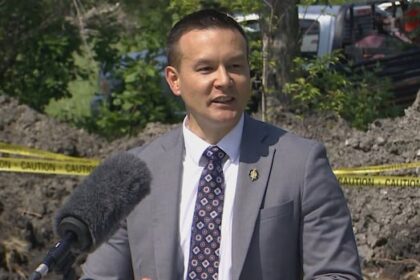
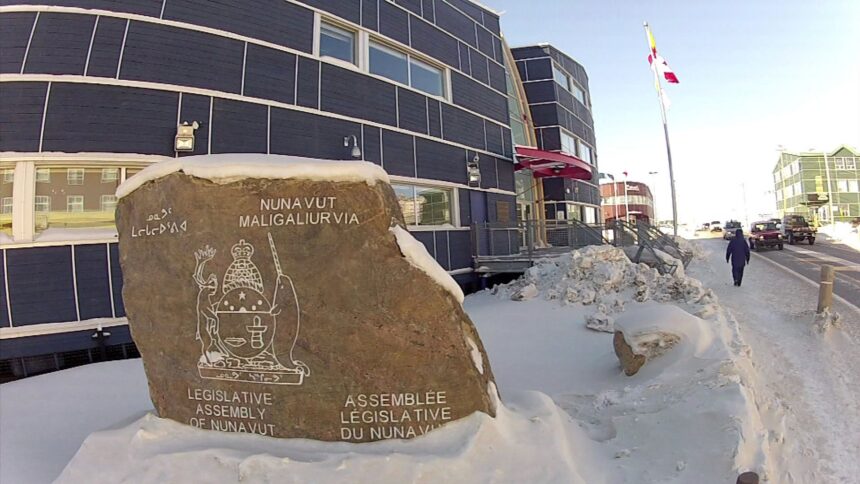
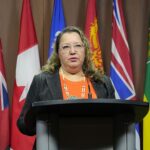
Nunavut’s child advocate says information presented to the territory’s legislature by the minister of Family Services regarding child welfare issues was “absolutely, patently untrue.” Jane Bates, the Representative for Children and Youth Nunavut, told APTN News that Gwen Healy Akearok has on multiple occasions made false statements to the territorial legislature. According to Bates, in a May 22 statement, Akearok said her department had “completed a full update of our standards and procedures manual, which now reflects best practices in social work with a priority focus on Inuit culture and maintaining connection to family.” Bates said she was astonished to hear this announcement. “I was listening to it thinking, ‘What? Hang on here,’” she said. “So I went back to them and I said, ‘You don’t have any section for children in care and you have no section for foster care. How is it that you’ve got a comprehensive standards and procedures manual?’” More recently, Bates took issue with the way Healy Akearok handled the acknowledgment that DFS had given incorrect numbers on children in care to the media. On Oct. 22, Healy Akearok rose in the legislature and said, “Recent public reporting has raised important questions about information previously provided by Family Services regarding children and youth receiving services. The department identified errors in the information initially provided, apologized, and supplied corrected information before publication.” Bates, who said she was the one who identified the wrong information, took umbrage at the minister’s claim that her department identified the errors itself. “That is absolutely, patently untrue,” said Bates. “That is not what happened.” In fact, CBC’s reporting acknowledged “Nunavut’s representative for children and youth Jane Bates, thought that figure looked suspiciously low, so CBC News asked the department for further clarity.” Bates provided APTN the text of a letter she wrote to the minister, in which she described Healy Akearok’s statement to the legislature as “factually inaccurate,” adding “your statement inaccurately attributes the identification of the error to the department and implies that it was corrected before the inaccurate information was published.” Bates also forwarded the text of Healy Akearok’s response, which read, “Thank you for your message, advice, and recommendations. At this time, after careful review, we’re satisfied with the information that was presented in the Assembly.” Nunavut Legislative Assembly. Photo: APTN “To be honest,” said Bates, “there are moments when it’s like pure dishonesty around what has been done. I have on numerous occasions caught the department telling me something that’s factually inaccurate.” APTN has repeatedly requested interviews with Healy Akearok to discuss the issue of child welfare in Nunavut. At first, her office was open to scheduling an interview, but after several follow-ups, we’ve received no response. APTN also reached out to Premier John Main, who told APTN News InFocus in May that the territory recognized the need for improvement and was “committed to making improvements” to the child welfare system. His office did not reply to our requests for an interview. ‘If I’m being perfectly honest, I’m angry’ Allegations of dishonesty are far from the only source of frustration for Bates, who said the DFS has sat for years on recommendations she’s made for its improvement since 2020. “If I’m being perfectly honest, I’m angry,” Bates told APTN. In September, Bates tabled her 2025-26 annual report. It noted a series of worsening circumstances, such as the fact that reports of sexualized violence jumped from eight events in 2024-25 to 22 events in 2025-26, though it added, “The Department of Family Services’ reporting of critical injuries also remains problematic, and the figures provided cannot be considered accurate or reliable.” Bates told APTN that the unwillingness of the department to implement changes is deepening an already longstanding crisis in child protection. “I’m angry that the department has not made significant change [or] improvement — this is now the fifth report,” she told APTN. “There was one in 2011, 2014, and then in 2023, of course, the report that declared that child welfare was a crisis in Nunavut. And then now we fast-forward to 2025: there were no significant changes again.” APTN recently reported on the text of notes for an excoriating presentation Bates delivered to the Nunavut Legislative Assembly, in which she alleged the territorial Department of Family Services was failing so dramatically that the department assigned to protecting Nunavummiut children was actually complicit in harming them. Bates acknowledged to APTN that she had prepared the notes and stood by their messaging. In that presentation, Bates threatened to ask the Nunavut Court of Justice to compel the department to heed the recommendations that have been overwhelmingly ignored since she began in her position. “Child welfare in Nunavut is the single biggest issue that needs to be addressed facing children, youth, and families,” Bates said, “and the very government services that are being funded to protect children are failing them. That is catastrophic.” She noted there are currently over 400 children in care, with as many as 80 placed in care outside the territory, yet the department knows neither where all the children in their care are located, nor even how many children it is responsible for. “The injustice that is currently occurring,” Bates said, “the violation of rights of children, youth and their families is egregious — egregious.” Jane Bates, Representative for Children and Youth Nunavut. Photo: APTN Like this since the beginning Bates began her role as Representative for Children and Youth in 2019 and said her most recent annual report and her address to MLAs in September were not the first times she’s flagged serious concerns in the DFS. “I issued a letter to the Department of Family Services about my intense concerns about what I was seeing in January of 2020,” she recalled. “It was less than six months into my appointment. And again, it’s the same message: ‘There are significant concerns in data collection. There are significant concerns around the safety of children in the care of the director.’” Bates said she didn’t make specific recommendations, but raised her concerns about information collection, DFS conduct in investigating child-protection matters and other issues of child safety. These were, eventually, the concerns she flagged formally, and has continued to flag. Referring to the damning Nov. 3 report by the auditor general into Nunavut child welfare, which found among other things that “the department [of Family Services] still could not consistently demonstrate that the basic safeguards intended to protect children [in their care] were being followed,” Bates said what was in the report was nothing new. “It’s the same message. And it’s really disheartening. These are all some of the recommendations the Representative for Children and Youth Office has actually made to the department dating back to 2022.” DFS lacks basic infrastructure Bates describes the problems at the heart of the failing department as complex, and not resolvable either by firing existing staffers and replacing them, or by hiking salaries to attract as much talent to the department as possible. Her plan for fixing DFS, rather, would begin with a full audit of all the communities in Nunavut in order to begin to develop a proper figure for the number of open cases involving children, comparing open cases with those that have been closed, and assessing the functioning of the process. “My understanding is the department did an audit, if you will, of about 1,400 files,” she said. “So that’s been done fairly recently. And I have requested the report on that to say, ‘What happened with this? Tell me what the outcome was.’” She said she has not yet received that information. Regardless, Bates returned to a single fault that she sees as a root of many failures in the department: the lack of a comprehensive standards and procedures manual. The DFS, she said, “lacks what I would call basic infrastructure or a basic foundation. The family wellness division doesn’t have a comprehensive standards and procedures manual that governs children in care.” Such a manual is not optional, Bates underlined. Comprehensive standards and procedures manuals are the road-maps organizations working with children in care are supposed to use to carry out their operation. “That’s your starting point,” Bates said. “Then you have to ensure that once you implement those standards and procedures, that your supervisors and managers are ensuring that the frontline social workers are maintaining those standards.” Bates said Nunavut’s DFS lacks specific standards and procedures for children in care, despite having more than 400 children in care. She said they lack separate documentation setting up standards and procedures for foster care. “There’s no program description [to clarify] this is the program, this is what it does, and here are the standards, i.e. the expectations, that help us fulfill our obligations under the legislation,” Bates said. “There is not a foundation on which the department is practicing child welfare or delivering child welfare services. You have to have infrastructure. You have to have a foundation. You don’t build a house from the roof down.” Against starting from scratch Bates noted she had told the department, following the auditor general’s 2023 report, that there was no need to reinvent the wheel by developing their own standards and procedures manual. She said she told the DFS that many jurisdictions across Canada (such as the Northwest Territories, whose protocols are online) have already developed standards and procedures that the DFS could adopt, which she framed as far preferable to the extreme demands of developing such a document from nothing. “You don’t need to create your own as you go,” she said she told DFS. “You don’t need to start from scratch. And I would recommend that you don’t do that because it’s a lot of work. Turn to First Nations who are delivering child welfare, who have standards and procedures, and build from those. Let’s build on expertise. “But the department has chosen to write their own standards and procedures.” One aim for a comprehensive standards and procedures manual, Bates said, was to determine what kind of operational model the department will rely upon. “From my perspective, and certainly working in a First Nation environment and Inuit environment, generally most child welfare agencies are moving towards a child-centered, family-focused approach, which means families are very much involved. They’re in the driver’s seat in relation to decision-making about their children, that family group conferencing,” she explained. “What we see in our work and our reviews is that once children enter into the care of the director, families… they disappear.” In September 2024, the department released the Ilagiitsiarniq Family Wellness Action Plan which outlines priorities for the department. But both Bates and the auditor general have told APTN that the plan doesn’t contain concrete actions to fix the problems with which the department is struggling. Ilagiitsiarniq Family Wellness Action Plan. Reliable data systems Children in the care of the DFS, Bates said, are the department’s legal responsibilities, and she argued the most basic level of taking responsibility is knowing who is in DFS care and where they are. The Nov. 3 auditor general’s report found “The department did not have a single, reliable source of information on how many children were in care or where they were placed, affecting both child safety and service planning.” “This is about having good data systems,” said Bates. “You have to collect adequate data on your children. So this is about having a system in place. They have Matrix [data processing system]. It was implemented roughly three years ago. It should be able to collect that data, but it requires people to input the data into it.” Nonetheless, the auditor general’s Nov. 3 report found the DFS relied on “a manually compiled list of children in care as the most accurate source of reporting information” rather than on the new Matrix system because employees had neither fully adopted Matrix nor become proficient in using it. The auditor general found errors in the Matrix system were caused by delayed filing by social services workers or confusion about how to input information. “The root cause of these realities continued to be a lack of staff capacity and chronic turnover challenges faced by the department,” the report noted. But Bates rejected the idea that there is inadequate staff or that turnover is preventing DFS employees from getting used to using the Matrix system. “The natural reaction is to assume it’s misappropriation of funds, or typically what you hear from the department is ‘This is a staffing issue,’” she said. “Staffing may be a component of it, but there are staff that are not using the Matrix system. There are staff not following the standards and procedures that are currently in place. Lack of comprehensive standards related to the department’s services contributes to a lack of clarity.” Bates cautioned against presuming the DFS’s problems are all caused by staffing issues. “It doesn’t account for the fact that there are staff currently in place that are not following standards related to investigations,” she said. “There are standards in place that are simply not being followed, yet there are staff available to do so.” Training and oversight While Bates predicted those outraged by various auditor general’s reports on the failing DFS might call for firings, she was uncertain changing or losing staff would help more than it would hinder the department. Nunavut Legislative Assembly. Photo: APTN. “Certainly in the 2023 auditor general report,” she recalled, “there was a change in deputy ministers. They went to standing committee in September of 2023. The premier made the decision to change deputies, which is problematic in and of itself because often what happens is you’re starting from scratch again. You lose that corporate knowledge. And there really needs to be a focus on accountability.” She argued the current situation with the Matrix system — and other issues in DFS — could potentially be resolved with further training. “You need to understand how to do a proper investigation,” she said, “and there’s also oversight. When I talk about oversight, I mean supervisors. Supervisors need to ensure that they are supporting the social workers completing the work, that they are meeting standards and procedures, that they are falling in line with what the legislative requirements are. And then supervisors are in turn to be supervised by managers.” Yet DFS, she said, “is not a department that is open to oversight.” The Child and Family Services Act is Nunavut’s legislation governing child welfare, through which the Department of Family Services derives its power. “What I conveyed to the standing committee was that this is all about follow-through and holding the Department of Family Services accountable. And everyone has to take responsibility to do that. That means bringing people to standing committee and asking for evidence — not statements that ‘things have been done,”’ she said. “When you say that you’ve done ‘this,’ show ‘this’ to me. Prove it to me.” An easy set of fixes? Bates said improving the system seemed to her a simple-enough process. “The fix is not that far away,” she said. “It’s not out of reach. And it’s not particularly difficult.” DFS would seem to concur. The department has agreed to all or nearly all recommendations suggested by the office of the auditor general of Canada, as well as recommendations suggested by the child advocate. “They agree,” Bates said, “and then they state the issue is follow-through.” DFS has failed to implement the overwhelming majority of recommendations it agreed to, in some cases dating back to 2011. She added that following the auditor general’s damning 2011 and 2014 reports, which included recommendations to which DFS agreed, the department appeared before the Standing Committee on Oversight of Government Operations and Public Accounts. “They basically, publicly said, ‘We have fulfilled these recommendations.’ But when the auditor general came in 2023, they found that that, in fact, did not occur.” Bates alleged the DFS operates in a unique manner unlike other government departments. “When issues are raised to our attention at the Representative for Children and Youth Office related to other departments, I can tell you our experience is very different than when we deal with the Department of Family Services,” Bates said. “If an issue is raised with another department, we have a protocol that requires us to contact the department and say, ‘This concern has been raised to our attention, and we’re going to do a review of this.’ And the response from the other departments is very quick, and they say, ‘Whatever you need, we’ll get it to you.’ That is not our experience with the Department of Family Services.” Lack of empowered oversight Bates argued, as she did in her presentation to MLAs, that the most pressing issue for DFS is its lack of independent oversight, especially striking in a department that has been consistently found in assessments over more than a decade to have remained unable to reach basic standards it has set for itself. “From the [perspective of the] Representative for Children and Youth Office,” Bates said, “we see significant failure in terms of oversight. From the front line right up to a fairly high level, there’s no one compelling people to say, ‘You’re not following standards,’ or ‘You’re not meeting the legislation.’ And when you don’t have this kind of oversight happening within your system, you’re bound to see a situation that we currently see.” At present, she said, the DFS develops, reviews, approves and implements all its own standards and procedures. This includes deciding whether to accept and enact recommendations from outside agencies. Recommendations from the auditor general of Canada, Bates said, or from her own office, are never more than suggestions, and are not legally binding on the family services department. Nor, she says, is there any consequence to DFS employees in failing to follow through on implementing recommendations on how to fail Nunavut’s neediest children less often than they are currently doing. “There is a consequence on the human level,” Bates noted. “It directly impacts the service to children, youth and families. And what we’ve seen is children and youth are being left at risk.” Jesse StaniforthOnline Journalist | MontrealJesse joined APTN as a producer after 16 years as a print and web journalist. During seven of those years, he covered the Cree Nation of Eeyou Istchee for community newsmagazine The Nation. Jesse’s writing on Indigenous issues has also appeared in Canadian Geographic, the Toronto Star, the Rover, The Eastern Door, Metro, and the Huffington Post. Continue Reading
Nunavuts child advocate accuses minister of Family Services of delivering absolutely, patently untrue statement to legislature


Leave a Comment