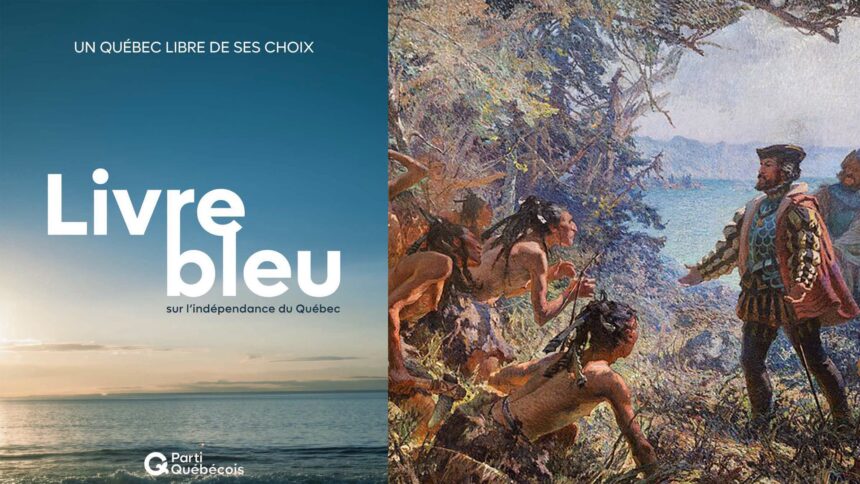
The Parti Québécois (PQ) is poised to win the upcoming provincial election on Oct. 5, and if they do, they have promised to call a referendum on Quebec’s independence from Canada within the first term – yet they’ve said little about how First Nations and Inuit fit into that plan. Over the past year, the PQ has been publishing chapters of its “Blue Book,” a formal plan for how an independent Quebec would function. However, Chapter 22, “Relations with First Nations and Inuit,” is currently a blank page with the promise that the chapter would be published “sometime in the summer of 2026.” APTN News contacted the PQ to find out whether the chapter was available and received no response. While there is nothing yet in Chapter 22, the PQ Blue Book nonetheless presents a version of the history between the French and Indigenous Peoples in Quebec. Red River Métis history professor Scott Berthelette studies French–Indigenous relations in New France at Queen’s University. He sees the PQ Blue Book’s narrative as dramatically simplifying a complex history of many nations, each with different interests, entering multiple alliances and waging wars. Berthelette told APTN that he noted in the PQ Blue Book a desire to mark the British as bad, while tying modern Francophone society in Quebec to roots predating the English conquest of Quebec. To accomplish that, Berthelette said, the PQ’s narrative imagines “these very accommodating settlers that really didn’t dispossess Indigenous peoples of their lands.” “When we try to have this nationalist narrative or this sort of moral lesson that the French were benign and fair colonizers,” he said, “you’re always going to have to omit some facts to make that narrative work.” The Blue Book history Indigenous relations with French colonists appear in several places in PQ’s sovereignty plan. The PQ Blue Book argues (in French) that “The Canadian system has perpetuated a colonial model of subjugation of First Nations, standing in sharp contrast to the relationships forged between French settlers and Indigenous peoples prior to the Conquest.” The British colonial regime, the PQ argue, is the basis of the present-day subjugation of First Peoples. Under the heading “Before the Conquest,” the PQ Blue Book suggests, “When the French settled in what would become Quebec, this did not happen as is sometimes understood today — that is, solely through the seizure of territory by force.” “Jacques Cartier Erecting a Cross at Stadacona, Where the City of Quebec Now Stands,” Artist Unknown (1859) Relations between the French and the First Nations were generally marked by diplomacy, trade, and a certain degree of mutual tolerance, though armed conflicts did occasionally arise between them. Consequently, the PQ argues, “the people of Quebec are well-positioned to understand the desire of Indigenous Nations to protect and promote their languages and cultures throughout Quebec and abroad.” As French colonists had little contact with Inuit, the PQ Blue Book makes virtually no direct reference to Nunavimmiut who occupy the 14 communities of Nunavik around Quebec’s northernmost land border. Mohawk Counterpoint This history does not sit well with representatives of the Mohawk Council of Kahnawà:ke (MCK). Taiaiake Alfred, PhD, is director of the Onkwehón:we Project for the MCK. In an email to APTN, he roundly rejected the narrative presented in the PQ Blue Book. “The relationship between First Nations and French settlers prior to the Conquest was not substantially different than what transpired later under the British regime,” Alfred said. “Both the French and British were colonial empires and the only difference between them was in terms of technique; their objectives both included dispossession of our people from our lands and usurpation of governing authority in our territories.” Alfred rebuked the Blue Book for downplaying the extent of conflict and violence in the relationship between First Peoples and arrivals from France. He noted the French were at war with the Haudenosaunee Confederacy from 1609 to 1650, and at war with the Kanien’kehá:ka/Mohawk people until 1667, and again at war with the Onondaga and Senaca in the late 1600s. “Peace between our people and the French was only settled upon after de Tracy’s campaign with the Carignan-Saliéres Regiment to destroy our people’s villages and food stores in 1666–67,” he said. Alfred also rejected wholesale the argument that the British conquest of New France was “traumatic” for his people. “In fact, Kahnawà:ke allied with the British in 1759 and took a neutral position militarily,” he said, “a fact which guaranteed the British’s later recognition of our lands and rights via the Treaty of Kahnawà:ke (1760) and led to the British reversing Jesuit and French settler fraudulent appropriations of our lands in the Seigneurie of Sault St Louis.” Photo: APTN file. MCK Council Chief Jeffrey Diabo expressed uneasiness about considering the document of only one Quebec political party, noting parties often take similar positions on First Nations issues even when they agree on little else. However, he took issue with the specific portrayal of French relations with First Nations portrayed in the Blue Book. “Quebec is trying to paint themselves in a more positive light, as opposed to the federal government,” he said. “[When the French] came here, they were sick, they were starving, and we helped to cure them. We helped to feed them. We taught them how to live off the land. We shared certain areas with them so they can live. “But over the course of time, that has deteriorated now. So when we look at it from a modern perspective, they are totally ignoring us and our issues. And they’re just basically moving forward as though they’re the only ones on the land.” The complexity of history Sébastien Brodeur-Girard is a non-Indigenous professor in the School of Indigenous Studies at Université du Québec en Abitibi-Témiscamingue, where he holds the Research Chair in First Peoples’ Language Rights and studies the history of First Peoples and colonialism. Speaking with APTN in French, he explained that the history of the French arrival in the territory and relations between First Peoples and French colonists was difficult to simplify. “Certain parties will propose a particular version of history,” he said, “because if we look elsewhere, well, things get a lot more complicated right away. We’re talking about dozens of nations interacting with one another over several centuries. We can’t simply say that the French were good, and then Canada came along to colonize the area.” Most Quebeckers learned in high school that the French were allied with the Huron-Wendat, and at war with the Haudenosaunee (Iroquois) Confederacy, who allied with the British and were already at war with the Huron-Wendat and Algonquins when Samuel du Champlain arrived in 1603. “Of course, there was a conflict [between French and Haudenosaunee] that lasted a very long time,” Brodeur-Girard said, “but at the same time, there was an entire Haudenosaunee faction that was also allied with the French.” Professor Sébastien Brodeur-Girard of Université du Québec en Abitibi-Témiscamingue’s School of Indigenous Studies, studies histories of Indigenous societies and colonization. Photo: Sébastien Brodeur-Girard/Facebook Likewise, he added, the Wendat (who are remembered for their alliance with the French) signed the Murray Treaty with the British in 1760, days before the British took Montreal. Brodeur-Girard pushed back against any narrative that reduces Indigenous peoples to allies or enemies. “In practically every case,” he said, “they were just pursuing their own alliance strategies based on their interests, which changed over time. They aren’t just there as secondary players who have to be aligned with another side. They had their own agenda.” When French colonists first arrived, he noted, they were massively outnumbered. At the same time, the French brought new technologies, such as firearms and metal pots, that many First Nations figured would give them a commercial, military and technical advantage. “There are a whole host of perfectly logical reasons why, without giving up their territory, [First Nations] didn’t oppose [French colonists arriving], because it could be beneficial for them, especially at first. Obviously, as time went on, they realized it wasn’t exactly what they’d envisioned at the start.” French approaches and intentions In the Saint Lawrence Valley, the French could only get what they wanted through trade and alliances, Brodeur-Girard said, but in other areas — particularly in the Fox Wars against the Meskwaki — they sought to defeat and destroy First Nations. “Especially in the Mississippi Valley and elsewhere,” he said, “the French had a genuine intent even bordering on genocide against certain Indigenous nations. There were military expeditions in the 18th century aimed squarely at exterminating those [Meswkaki] nations.” There was never any question of the French being friends with Indigenous people, he noted. “It was ‘We’re friends with our allies.’ If there are Indigenous peoples who are our allies, we’ll treat them better. If they’re our enemies — regardless of whether they’re Indigenous or not — we’ll go to war.” “A new map of ye North Parts of America claimed by France under ye names of Louisiana, Mississipi, Canada & New France with the adjoyning territories of England & Spain” by Herman Moll, 1720 The Blue Book narrative of history, he said, “seems to imply there was perfect harmony and friendship, which wasn’t the case at all — there were just converging interests at certain times.” The defining policy of the New France era, Brodeur-Girard explained, was forging commercial, diplomatic and military alliances that aimed to best position France to profit from its presence among the First Peoples of New France. “Does that mean the French were more naturally inclined to view Indigenous peoples as their equals? The answer is no,” he said. “There was a sense of cultural superiority that was shared by all Europeans.” This meant, he said, that when needs shifted, alliances changed and European settlers no longer relied on Indigenous people. “There were no Francophones who subsequently stepped up to defend Indigenous peoples specifically,” Brodeur-Girard said. “We need to be mindful of that.” Berthelette noted that Jean-Baptiste Colbert, King Louis XIV’s minister of State, spoke of the French and First Nations becoming one people and one blood. “According to the French colonial logic of the 17th century,” Berthelette explained, “there was the sense that becoming one people meant a French people. By French men marrying Indigenous women, the children themselves would be French. They would, of course, be raised in this cultural context of being French and this religious context of being Catholic. So there was this expectation then that Indigenous women were merely there to help propagate this French settler population.” The invention of Indian residential schools With these ideas in mind, Berthelette said, Catholic missionaries and religious orders established the first rudimentary Indian Residential Schools in the early 17th century. In his paper “Indigenous Residential Schools in New France,” Berthelette explains that the first boarding school for Indigenous students was opened in 1620 by the first Catholic missionaries to New France, the Récollets. Subsequent boarding schools for Indigenous children were opened by Jesuits, Capuchin monks and Ursuline nuns. Professor Scott Berthelette of Queens University studies the history of French-Indigenous relations. Photo: Scott Berthelette/Facebook These schools were gentler than the later wave of Indian Residential Schools, especially in their willingness to allow students to speak their own languages. This wasn’t something the schools offered out of benevolence, Berthelette notes. Rather, missionaries hoped letting students retain their own languages would inspire the children to convert their parents to the French way of life. The French were also too outnumbered to compel Indigenous children to stay in the schools and become completely assimilated. “If Indigenous parents are like, ‘We’re going on the winter hunt. We want our kids back,’ what can the Ursuline nuns really do but acquiesce to what their allies are asking for? That’s why I don’t think we hear about residential schools in New France as much. It was a short run experiment and they weren’t very successful in terms of what the French were trying to achieve.” No violent conquest Responding to the Blue Book’s assertion that the French did not settle in Quebec “solely through the seizure of territory by force,” Berthelette noted that such forcible seizure of territory was rare during the early years of the territories that would become Canada and the United States. Even in the British Thirteen Colonies, which became the USA, Berthelette said most of that territory was cleared by the progress of European diseases wiping out Indigenous communities. Brodeur-Girard agreed, noting, “In fact, one of the key points from the Indigenous perspective is that there was never a conquest. Hence the fact that these territories were never actually ceded. In fact, that’s the crux of the matter when events unfold gradually over several years, decades, or even centuries. Indigenous history is one of having been gradually squeezed out.” Yet Berthelette argued that even without violence, territory was seized by colonists. He gave the example of an Innu eel fishery near Sillery, outside Quebec City. Because Innu harvesters and their communities followed the seasons, they would follow the caribou north during winters and return to the water when the eels were most populous. “A View near Point Levy opposite Quebec with an Indian Encampment,” by Thomas Davies (1788), depicting the area of modern-day Lévis, Quebec. Eventually, the Innu returned one spring and discovered the eel fishery had been completely depleted by French settlers. “They weren’t expelled by gunpoint, and they hadn’t sold their lands, but they were still dispossessed of this resource extraction point in their territory. So they went and they fished somewhere else. And by the 1660s, the Innu never went there anymore. They were essentially driven off from this formerly resource-rich part of the St. Lawrence Valley.” A people whose hunting and fishing areas are completely exhausted by settlers and settlement, Berthelette said, have essentially had that part of their territory seized. The Great Peace of 1701 All parties agree on the significance of the Great Peace of 1701, signed in Montreal between the governor of New France and 39 First Nations leaders (accompanied by some 1,300 members) representing a massive territory blanketing the east of the continent. “This was the first time we see so many people come together to sign this general peace agreement,” Berthelette said. “It does bring about a prolonged period of peace.” Berthelette also noted that the Peace was tested within three years, when a group of Odawa warriors attacked a Haudenosaunee village on the north shore of Lake Ontario, leading the Haudenosaunee leadership to complain to the governor of New France, calling for justice but also seeking to prevent the violence from spiralling into something more extreme. In that way, he said, the Great Peace was an opportunity for French powers to position themselves as an authority over the Indigenous peoples in New France. He cites historian Gilles Havard, whose 2001 book The Great Peace of Montreal of 1701 proposes the French were able to wage “a silent war” against First Nations. “The Great Peace of Montreal” by Jean-Baptiste Lagacé (1921) “[Havard] talks about how the French initiated a kind of Pax Gallica, a French peace,” Berthelette explained, “And it was really a French imposed peace on the Indigenous nations who had formerly fought in the Iroquois Wars. The French were able to extend forms of domination over Indigenous peoples, and used the silent war that was built on concepts of arbitration and mediation.” Even First Nations who were allies of the French became subordinate to them under this reading of the Great Peace, he said. “There’s a sense if there’s any conflict happened, the French governor has the final word on how it’s going to be resolved. So the French are able to set themselves up in 1701 as the arbiters and mediators of these 39 Indigenous nations of the Great Lakes.” In this position, Berthelette said, the previously outnumbered French were approaching a powerhouse position of having 40 First Nations allied behind them. “They don’t have the same number of settlers that the English do,” he said. “But now if there is a nation that they want to destroy — and this happens in the Fox Wars with the Meskwaki people — the French are able to stand in this powerful alliance. And then even more so against the English.” Berthelette noted that the First Nations signatories to the Great Peace had their own ideas about what the Peace meant wholly unrelated to French power. “They talked about things at the Great Peace that I think are still relevant today. The dish with one spoon, that famous wampum belt: this idea that you’re going to share the hunting territories and live in peace, and that the resources of the land are open for all.” Following 1701, he said, Haudenosaunee Nations and Anishinaabe Nations indeed shared hunting territory north of Lake Ontario and south of the Ottawa River. “Another metaphor that’s talked about is the Tree of Peace,” he said. “It’s a Haudenosaunee metaphor, this idea that we all shelter under this Tree of Peace together and live in harmony. So it’s not just about French arbitration and mediation. “I don’t want to just see [The Great Peace] as the cynical French way to control Native people. I think Indigenous people had their own thoughts about what peace meant to them as well.” End of French rule There were many factors that brought about the end of the alliance of 39 First Nations and the French, but Brodeur-Girard cites declining Indigenous military power as a key consideration. For many years, he said, both French and English colonists wanted Indigenous people as military allies, and feared having them as opponents. He noted that First Nations fought in the US War of Independence and provided military support up until the War of 1812. “But after that, there were no more major conflicts,” he said, “so there was no longer a need for military alliances. The Indigenous peoples had suffered greatly from diseases, so their numbers had dwindled. After that, demographically, the settlers outnumbered them and needed more land, so that’s when the balance of power shifted completely.” “Montagnais [Innu] Camp, Pointe Bleue [Mashteuiatsh], Quebec” by Winslow Homer, 1895 With the population of settlers growing, he said, trade also began to shift as the furs waned and timber became a more popular resource to exploit. “With fur, you needed the Indigenous peoples, but with timber, the Indigenous peoples became an obstacle,” Brodeur-Girard explained, “because they were in the places you wanted to clear. Interests changed, and that’s when the colonial system really took hold — not that everything was perfect before, but that’s what really became established starting in the 19th century. And at that point, well, the French and the English were in the same country.” However, Brodeur-Girard dismissed the Blue Book’s characterization that “for both First Nations and French settlers, the British Conquest was a traumatic event that gave rise to political consequences whose repercussions extend to the present day.” “It actually didn’t happen that way,” he said. “The Indigenous peoples negotiated their alliances based on their own interests. Once the French lost, they said, ‘It’s in our interest to negotiate with those who defeated the French,’ so they negotiated agreements with the British. Therefore, the imposition didn’t happen automatically.” What a “comfortable history” obscures For Berthelette, the PQ’s Blue Book raises questions, and not just about the party’s understanding of its ancestors’ history with First Nations. “I see it as a very comfortable history that people in Quebec like to tell themselves. I’ve heard this even from friends of mine who are Quebecois, that, ‘We were colonized as well.’ Well, you could still be a colonizer, but then also be colonized.” He said that French people are significantly better represented in Canada’s national history than Indigenous people, which allows for comfortingly simplistic narratives about First Nations to proliferate. Despite having a formal relationship with Ottawa, Brodeur-Girard noted, Indigenous peoples are also mentioned in, and subject to, Quebec laws. “The consequences of ceding such territory to colonization, to logging, the construction of dams and all that,” he said, “it obviously had major impacts on Indigenous lands and on Indigenous peoples themselves, and that’s the entire province’s responsibility. That’s colonialism too, obviously.” Atikamekw land defender Dave Petiquay in a confrontation with a logger during protests against Quebec’s plan to update forestry management in the summer of 2025. Photo: Lisanne Pittikwi, Facebook Berthelette argued that control over First Nations was what French colonists sought from the beginning, and he said the PQ Blue Book’s history fails to acknowledge the reality of France’s intention to subjugate what it saw as inferior peoples. “The French could not dominate their Indigenous allies,” he said, “but it did not mean that they did not continue to yearn for an alliance where Indigenous peoples were forced to obey the French. “They were in this position where they wanted to do one thing, but they didn’t have the power to do it. But it doesn’t mean that should exempt them from this more complex history, I don’t think.” What’s in it for Indigenous peoples? While the Blue Book history offers a positive assessment of historical relations, and makes promises to “negotiate self-government agreements with each of the Indigenous peoples (nations) of Quebec,” Berthelette said he wondered about the PQ’s relationships with modern Indigenous peoples. Those communities may be curious about the PQ’s Blue Book promises to allow them to manage their cultural budgets, integrate into Quebec programs and receive support for their languages, and see greater representation of Indigenous people “on our national broadcaster’s airwaves.” Read more: ‘There is no Quebec nation’: Grand Chief delivers stern message to Quebec’s Justice minister Chief barred from entering Quebec constitution meeting with Eagle Staff However, recent years have proven First Nations in the Quebec territory have advocated for a say in forestry management, mining (especially uranium mining) and hydroelectric development, as well as with the protection of the Boreal caribou. A clash over an aggressive arrest of an Elder in the Innu Nation of Ekuanitshit in February for possession of a woodland caribou was a reminder of the tense relationship between Indigenous people and game wardens. Many First Nations wish to gain control of policing in their communities, while calls have been growing from Inuit in the Nunavik region to have police who speak Inuktitut and are familiar with their cultures. Nunavimmiut, who suffer tuberculosis at a rate 1,000 times higher than Canadians in the south, have likewise called for an overhaul of TB care after their Regional Board of Health and Social Services announced in April that Quebec had failed them in TB management and called in the Red Cross. Meanwhile, there are widespread demands from Indigenous communities all across Quebec for the province to address systemic anti-Indigenous racism in health care and detention centres. Quebec has yet to adopt Joyce’s Principle. None of these issues is a federal responsibility: all are subjects upon which First Nations and Inuit have pressed the CAQ government to address in recent years. As much as Berthelette is interested in the PQ Blue Book’s vision of Quebec history, he said such current issues are more pressing when considering a political manifesto. “What are they promising to do for Indigenous people today?” he wondered. Tags: Blue Book, Colonialism, First Nations sovereignty, Kahnawà:ke Mohawk Territory, Mohawk Council of Kahnawà:ke (MCK), Parti Quebecois, Professor Scott Berthelette, Professor Sébastien Brodeur-Girard, Quebec, Quebec City, Quebec Election, Quebec independence, Quebec sovereignty, The great peace, The Great Peace of Montreal of 1701 Continue Reading
PQs history of Quebec is misleading: Indigenous historians


Leave a Comment