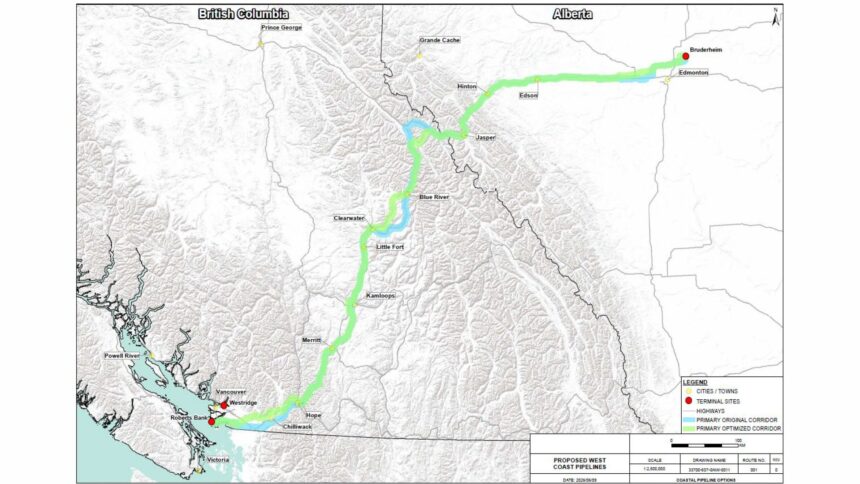
The Union of B.C. Indian Chiefs (UBCIC) is promising to fight against the west coast Pacific Link pipeline designated to be in the “national interest” by Prime Minister Mark Carney today. “We have a duty and an obligation to protect our rights to the fullest extent of the law and we have every intention of doing that. This is not a cake walk, this is not a ‘gimme’, this will be hard-fought in the court rooms, and if necessary, with boots on the ground,” said UBCIC president Grand Chief Stewart Phillip. Phillip joins a growing chorus of First Nation voices speaking out against Pacific Link. Five other west coast chiefs spoke out about the pipeline in a late afternoon news release. “We demand that the legal principle of ‘free, prior, informed consent’ enshrined in the United Nations Declaration on the Rights of Indigenous Peoples Act and the Declaration on the Rights of Indigenous Peoples Act be fully engaged in ‘all’ fast-tracked projects sponsored by the Major Projects Office,” Phillip said. He called the Pacific Link pipeline unique and that it has tossed aside “fundamental pillars” of Canada’s relationship with First Nations. Heiltsuk K̓áwáziɫ Chief Marilyn Slett, stated, “At the heart of our fight is keeping our coast super tanker free and protected from jeopardizing our way of life, economy and future. Whether the tankers travel south or north it’s all the same. They threaten the health of our ocean and an oil spill is devastating to our communities.” “Moving another million barrels of oil across major salmon rivers and through salmon migration routes in the Salish Sea could have devastating impacts on our inherent title and fishing rights,” said Chief Dalton Silver, Semá:th First Nation. “Prime Minister Carney needs to understand that today’s pre-approval of a new crude oil pipeline and tankers project without a full assessment of the risks of a rupture or oil spill, and without the consent of impacted Nations, is both unwise and unlawful.” Earlier today, a First Nation along the route of the proposed Pacific Link said it’s considering “court or other action” against the project. The Coldwater Indian Band (Coldwater) says hundreds of kilometers of the pipeline will cross Nlaka’pamux territory, just outside of Merritt, B.C. The line is the first project to receive national interest designation under the Building Canada Act. The pipeline would be Trans Mountain’s third through the Coldwater Valley. The Line 1 pipeline bisects Coldwater’s primary residential reserve and has been the subject of a long-standing dispute, including current litigation, according to a news release from the band. Line 2 (the Trans Mountain Expansion Project) was completed in 2024, after what the band calls significant court battles “and a re-routing of the pipeline to avoid the community’s aquifer.” “In the coming weeks Coldwater will be considering whether court, or other, action is needed to respond to the “national interest” listing decision on Line 3,” the band said. “There is anger in our community today, as we hear that Canada has given the green light to a third Trans Mountain pipeline through the Coldwater Valley. “The Crown’s duty to consult and accommodate Coldwater remains unfilled and Canada and Trans Mountain are not legally or respectfully operating in our reserve” said Coldwater Vice-Chief Michael Smithers. “This morning the Prime Minister said Canada has to do things differently, but when it comes to our concerns and our rights it’s more of the same – delay, not the speed and certainty he provides the private sector.” According to a summary of the consultations with Indigenous communities along the pipeline route, they were given just two months for consultations, and that was still more than the government initially planned. The consultations were to only take place over one month but was extended to two after Indigenous leaders raised concerns about the tight timeline. The summary said Indigenous groups decried the lack of information about the project which prevented them from fully assessing its impact. A Treaty 8 chief called today’s announcement “a foregone conclusion.” Sturgeon Lake Cree Nation also issued a statement reminding both Canada and Alberta “that this is Treaty land, and that free, prior, and informed consent is not achieved through ‘loan guarantees’ or ‘conditions.’” “We are governments and Nations, not investors or stakeholders,” said the statement from Sturgeon Lake Cree Nation Chief Sheldon Sunshine. “In rushing to make this decision, the federal government – in an act of apparent appeasement to our separatist Premier – has dismantled the federal environmental assessment regime through regulation and put in its place a plainly unconstitutional process that does not uphold the honour of the Crown,” Sunshine said. “In doing so, both Canada and Alberta have created further division and encouraged litigation rather than meaningful, good faith engagement and collaborative decision making. Sunshine noted that “certain Chiefs attended today’s announcement. We reiterate that no one with authority to represent Sturgeon Lake Cree Nation attended, nor do we support it. In fact, we were not even invited likely because we are one of the strong voices who will not accept the short-circuiting of our Treaties.” Prime Minister Mark Carney promised his major projects agenda would not interfere with the Canada’s obligations under the United Nations Declaration on the Rights of Indigenous Peoples. That declaration outlines the need for free, prior and informed consent before decisions are made that can adversely affect the rights and lands of Indigenous communities and people. “I don’t know how they can commit to rigorous consultation and building in partnership with Indigenous communities when they haven’t dealt with their existing obligations yet and don’t seem to be listening to our concerns,” Smithers said. “We’d like the Prime Minister to know that we are for Canada showing up and fulfilling their constitutional obligations. And I can tell you, that is not happening on our reserve or in our territory – there is unfinished business that needs to be dealt with.” “The urgency Canada shows to move major projects forward and overhaul the regulatory scheme to make it happen does not seem to apply when it comes to our community – Canada is not moving with urgency to resolve Trans Mountain’s authorized use of our reserve by their first pipeline nor is their urgency to grapple with concerns about impacts from a third pipeline before it was approved today,” Smithers further noted. In 2017, the Federal Court of Appeal ordered Canada to consider modernized terms for the use of Coldwater’s reserve, consistent with the minister’s fiduciary obligations to the community. Canada does not dispute this requirement but has yet to modernize terms of use, the band said. The community argued it wasn’t protected from the impacts from the original pipeline and that compensation for use of the reserve by oil companies needed to be updated. According to an article by the law firm BLG, in 1952, the Trans Mountain Oil Pipeline Company sought a 60-foot right of way (ROW) through one of the Band’s reserves for the purpose of building an oil pipeline. The Band Council passed a resolution approving the ROW, and an Order-in-Council was passed in March 1953 approving the ROW. The Band received $1,292.00 for the ROW, calculated at the standard rate of the time, and has levied property taxes for the easement since that time. “In 1955, Trans Mountain entered into an agreement with the Crown relating to the easement. One of the terms stated that Trans Mountain shall not assign the ROW without the written consent of the Minister. The pipeline was subsequently built, and carries approximately 300,000 barrels of oil per day from Alberta,” BLG said in the article. The outdated agreement doesn’t sit well with Coldwater. “Our members are beyond frustrated. We have been waiting years for answers and now the government approves a major pipeline in record time” Smithers said. “Our community has been ravaged by climate emergencies: the 2021 atmospheric river event, wildfires, you name it. These impacts compound with harms from existing development and raise a serious question about whether our territory, our valley, and our rights can survive the impact of another major pipeline. Canada has chosen to shut the door to that conversation without even assessing the impacts or alternatives. That’s not right, and it is not what the constitution requires.” The Pacific Link project, estimated at between $35 billion and $44 billion, is to be split among Trans Mountain Corp., which is a federal Crown corporation, and the Alberta government. First Nations communities will be offered a minimum of 10 per cent ownership interest, financed through federal and province loan programs. The roughly 1,250-kilometre pipeline would carry upwards of one million barrels of crude oil per day from Bruderheim, Alta., to a port near Delta, B.C., for shipment to international markets. “A pipeline to the West Coast is part of our mission to transform our economy to double our non-U.S. exports over the next decade,” Carney said at the announcement. The goal is “to unlock the full potential of Canada as a global energy superpower.” Read more: Carney offers First Nations 10% stake in Pacific Link pipeline, designates it as project of ‘national interest’ UBCIC calls on Carney, Smith to halt pipeline advancement Lawyers at West Coast Environmental Law said they are extremely concerned about what it says is a project largely funded by taxpayer dollars. “The listing decision has occurred before any environmental assessment and means the only question now is “how” not “whether” this costly new pipeline and tanker project will be built,” the firm said. It also noted that along with other fossil fuel expansion plans, it is expected to double crude oil tanker traffic in the Salish Sea. With files from the Canadian Press Continue Reading
West Coast chiefs join First Nations along Pacific Link pipeline in denouncing government over lack of consultation



Leave a Comment