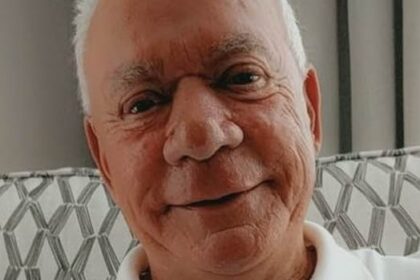
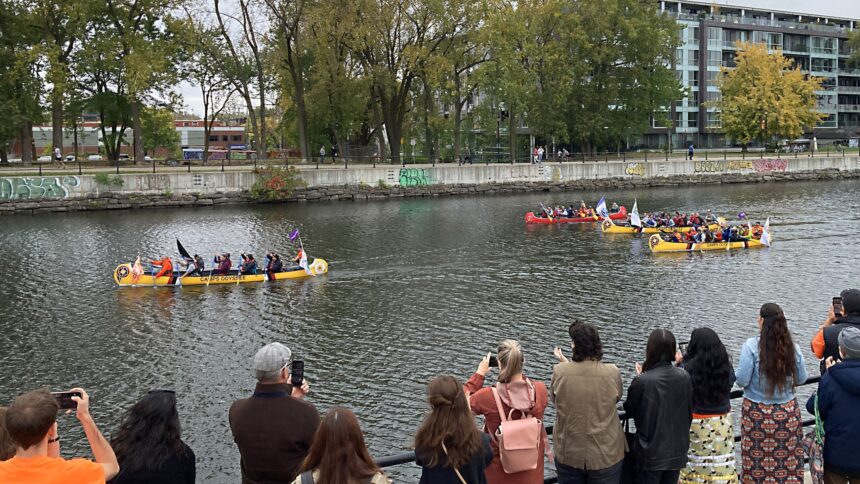
Warning: This story discusses suicide and sexual abuse. The crowd surrounding the Lachine Canal just south of downtown Montreal broke into cheers and applause as the four rabaskas (large Algonquin-style canoes) approached the shore, bringing an end to the 350 km journey of this year’s Mamu Nikantetau expedition on National Day for Truth and Reconciliation. Led by Dr. Stanley Vollant, an Innu from Pessamit and the first Indigenous person to become a surgeon in Quebec, the 5th Mamu Nikantetau expedition brought together 29 mostly Indigenous participants. The group travelled from the Algonquin Nation of Kitigan Zibi, down to Ottawa and then to the Mohawk communities of Kanehsatà:ke and Kahnawà:ke, before reaching their final destination of Montreal. “People don’t know each other at all at the beginning,” Vollant told APTN News. “They have to talk, they have to know each other, they have to know their past, their trauma, what they are heading for and their objective, and then we have to respect each other, respect the differences.” For the expedition to succeed, he explained, the group must figure out everyone’s strengths and weaknesses and get to know one another well enough that they can work together to achieve the common goal of carrying the voyage through to its end. “We have to paddle at the same time,” Vollant said. “It’s very difficult at the beginning to paddle at the same time.” Dr. Stanley Vollant greeted by supporters after the Mamu Nikantetau expedition arrived in Montreal on Sept. 30, 2026. Photo: Jesse Staniforth/APTN The Walk Mamu Nikantetau, meaning “together we move forward” in Innu-aimun, began with Vollant’s undertaking of a six-year, 6,000-km walk he called Innu Meshkenu (or “Innu Trail”) that he carried out between 2010 and 2016. Vollant walked those 6,000 kilometres in the hope of encouraging Indigenous youth to develop healthy life habits and stay in school. But he’s also spoken about how the project grew out of a severe depression in 2007 that left him struggling with severe suicidal thoughts. “Anger can transform your life into misery or to death,” he said. He described facing his self-destructive feelings and overcoming them. “I’m so happy,” he said. “Nineteen years after, that was the wisest choice. Death is everywhere. Death is going to get you for sure. Income taxes and death are supposed to get you, but sometimes life is a difficult choice.” It was no accident that the expedition ended on National Day for Truth and Reconciliation. Vollant said his mother survived residential school, but never told him about it. When he speaks of his depression — as when he speaks of the high rate of violence Indigenous women face — he says it all connects to the legacy of residential schools. “My mom went to a [residential] school; she was abused, I suffered from it, and I didn’t know when she was young, why she was drinking to her death,” he explained. “She passed away when she was 52 years old, and I was not happy. I had a lot of anger towards my mom. Why was she like that? “But when the Truth and Reconciliation Commission started, all the people started to speak, and my aunties and uncles told me, ‘Your mom was sexually abused in residential school.’ So I started to understand why she was like that, why she was drinking.” Unfortunately, Vollant said, he learned these crucial facts about his mother’s experiences ten years after she died, a decade in which he struggled with suffering, confusion and rage. “We have to change the paradigm and transform this anger into a positive thing, constructive, and this kind of expedition changed lives,” he said. “Seeing the people [on the expedition] talking about the effect on their lives, my walkers of the last 10 days, told me, ‘This changed my life,’ and ‘I want to change my life.’” Vollant said one youth told him he’d stopped drinking and taking drugs, and found the means to continue his sobriety in relation to the land. “And I will stay in touch to make sure he will continue that path,” he said. Walking – and paddling When Vollant first undertook his 6,000 km walk in 2010, he said he did so with the knowledge that walking is a way of life for Indigenous people, particularly his grandparents, who traveled their traplines on foot. “When I was young, I was listening to those stories, but when I started to walk, I said, ‘Those are giants, to go from a river to another lake, to cross half of the province, half the country. And without any support, like I have!’ “So I was proud of my grandparents, but I’m prouder now, because I walk on their path and bring people on the land, connecting them with Mother Nature, and being grateful and connecting them to the spirituality of Indigenous people. I think that’s a healing process, and I saw the result, and I do that for myself every year, because that’s energizing.” Elder Édouard Kistabish (left) leading the members of Mamu Nikantetau expedition after docking in Montreal. Photo: Jesse Staniforth/APTN News Elder Édouard Kistabish, on his 4th Mamu Nikantetau expedition, knows what Vollant is talking about. Born into the Algonquin community of Pikogan, Kistabish was raised in the traditional nomadic manner on the land before he was taken to a residential school at the age of eight. When he finally returned, he said the land was where he found some peace. “Once I left residential school, I went into the woods often, especially in the fall,” he told APTN in French. “We’d go out on the river in a canoe, paddling. I like that. Because you can see more or hear more when you’re paddling. If you have a motor, you don’t hear much. You see the trees and all that, but you don’t hear if there’s a moose nearby in the woods leading you along or coming toward you.” These experiences, he said, returned him to the time when he was a child, still nomadic on the land with his parents. “When I was out in the woods,” he said, “our parents would paddle a lot. There wasn’t necessarily a motor. We’d usually get around by paddling.” Vollant said paddling helps connect participants to the present moment, even if it’s a moment of challenge. Going overboard Paddlers face a variety of challenges. On Sept. 27, one of the four Mamu Nikantetau canoes capsized, and the paddlers ended up floating in their life jackets. “We had a very good security plan, so everybody was out of the water after 20 minutes,” Vollant explained. “All the emergency services were there, because we had all the numbers, and so it was done within a few minutes, but it’s something that could be a tragedy.” The paddlers who went into the river included Kistabish. “When he was in the water, all the youth were after him,” Vollant said. “That’s the thing that has disappeared with residential school and colonization in our communities; the sacred link between the youth and the Elders has been destroyed, but we have to rebuild that. That’s a profound value of Indigenous people, the Elders and the youth. There’s something very sacred to this relationship.” Vollant said Kistabish was the first person from the capsized canoe to burst out laughing once they were safe on dry land, and the first to announce he’d be getting back in the next day to continue the voyage. “So all the people said, ‘Okay, we’ll go with you,’” Vollant said. “And that’s family.” All members of the 2026 edition of the Mamu Nikantetau expedition gather for a song following the end of the expedition. Photo: Jesse Staniforth/APTN News Intergenerational healing Chief Chantal Kistabish from Abitibiwinni First Nation was present to greet her father, Édouard, at the end of the voyage. She told APTN that both her parents survived residential school after each first being raised nomadically on the land. “They say the impacts of the residential schools will be felt for up to seven generations,” she told APTN in French. “I’m part of the second generation. My brother has children — his children are the third generation of our family. We’re still feeling the effects of the residential schools. Little by little, it’s thanks to events like this and the fact that we’re sharing our stories that we’re able to heal gradually.” Chantal Kistabish said prior to the sharing of stories that occurred during the Truth and Reconciliation Commission, the subject of residential schools felt taboo in many families. “It wasn’t until the various commissions and hearings took place — when residential school survivors began to speak out — that we truly began to understand what had happened,” she said. “Because at home, we don’t talk about those kinds of things. That’s when we began to understand that this is why they acted the way they did.” As a community leader, Chantal Kistabish has been in a position to see the effects of both residential schools and the process of recovering from them play out across her community. She said there have been many changes in the way people discuss and confront residential schools and their aftermath, and these changes continue. “You can’t say it’s completely healed. You can’t really recover from these things,” she said. “You can only learn to live with your wounds. But little by little, people are wanting to move on; they’ve become aware of their wounds. We’re also seeing more and more people who are stopping their alcohol or drug use. But it can be a process that takes several years.” Her father said that his understanding of the world is that his people will continue existing as they always have, regardless of the challenges they face. “We’ll always carry on no matter what happens — the Indian Act, all the changes to the laws,” he said. “Sure, sometimes the government has tried to stop us by changing the laws on trapping and hunting, but we’ll always be here practicing these activities. Hunting, fishing, canoes, canoeing — we’ll always do these things. It’s part of our way of life.” Imagining reconciliation as a state of affairs rather than a day He appreciated the events marking National Day for Truth and Reconciliation, but Édouard Kistabish said he hoped to see something greater. “Maybe — I’m dreaming here — it could be permanent,” he said. “True reconciliation. Not just saying, ‘September 30 is Reconciliation Day.’ After that, the next day, we move on to something else. After two weeks, we’ve already forgotten about it. I, as an individual, as an Anishinaabe, as a former victim of the system, would like it to be permanent — not just a single day, but always.” Dr. Stanley Vollant, flanked by Montreal Mayor Soraya Martinez Ferrada, speaking to members of the Mamu Nikantetau expedition and supporters in Montreal on Sept. 30, 2026. Photo: Jesse Staniforth/APTN Photo Vollant hopes, at least, that as the Mamu Nikantetau expeditions continue, more people will begin to come to greet the voyageurs when they arrive. But he said he worried the general population in Quebec knew too little about Indigenous issues, and that political leaders seemed not to care. “[In] the election process in Quebec, Indigenous issues were not on the table,” he said. “So few or none, and we are here. We are living on the land that gives the energy. All the extraction of the land comes from our land. So we should be part of the conversation. We should be building up on Indigenous youth and human resources. I think we’re going to have much power as a country.” Read more: The travelling Innu surgeon ‘There were 13 people walking, but thousands were with them’: Marchers end one journey in Quebec City Yet he said he didn’t imagine reconciliation as a concept that Quebec or Canada will make a reality in the near future. “Maybe I’m going to be very old, or my kids are going to see it,” he said. “I see small steps, but I would have loved to see the steps done faster.” Now that the expedition is done, Vollant said he’s looking forward to getting some rest after ten days of physical demands and suffering — ahead of his next challenge. “My mental, spiritual, emotional axes are fully energized,” he said, “so I will be able to continue my physical work. “I will take some time off, not running and biking. I’m doing a half marathon in 10 days, but I will be good.” Continue Reading
Life is a difficult choice: Innu surgeon completes 350 km paddle with youth, Elders

Leave a Comment